Approaching 4-Betting in PLO
A practical breakdown of 4-betting in PLO, covering optimal ranges at 100 BB and key adjustments for low- and mid-stakes play.


In Pot-Limit Omaha, preflop equities tend to run much closer together than in other poker games. Although defining, this characteristic of PLO is often underestimated when players build their preflop strategies.
To put this into perspective, let’s briefly compare PLO with No-Limit Hold’em. In a heads-up pot in NLH, pocket Aces have roughly an 85% to 15% equity advantage against a random hand. In PLO, even the strongest possible holding from a pure equity standpoint — AAKK double-suited — has a significantly smaller edge. Against a random hand, its equity is closer to 70% versus 30%.
Combined with the pot-limit betting structure and the enormous number of viable preflop combinations, this leads to a fundamentally different approach to preflop aggression — particularly when it comes to 4-betting.
In this article, we’ll focus on the most essential aspects of constructing a 4-betting strategy in PLO:
- When should you 4-bet?
- Which hands should be included?
- Is it correct to 4-bet only Aces?
Is 4-Betting Only Aces Enough?
Many players adopt an extremely simplified approach, restricting their 4-betting range to AA combinations only. At first glance, this seems reasonable: even the weakest AA hand retains a slight preflop equity edge against most holdings.
However, a closer look at GTO-based solutions shows that this strategy is incomplete. While Aces form the backbone of any 4-betting range, optimal play includes additional hands — particularly in wider positional configurations.
Whether you should incorporate those hands in practice depends on several key factors.
Firstly, assess whether your opponent is capable of 3-betting hands other than Aces. While most regulars do, you will still encounter players whose 3-bet range is almost exclusively AA.
Secondly, consider how your opponent reacts to 4-bets. Do they fold a portion of their range, or do they continue with nearly 100% of their 3-bets? This response has a significant impact on the profitability of non-AA 4-bets.
With that in mind, let’s examine optimal 4-betting ranges at 100 BB stack depth, assuming a standard PLO50 rake structure, and see how they translate into practical play.
4-Betting from UTG versus Middle Position
The most important takeaway in this configuration is straightforward: always 4-bet Aces.
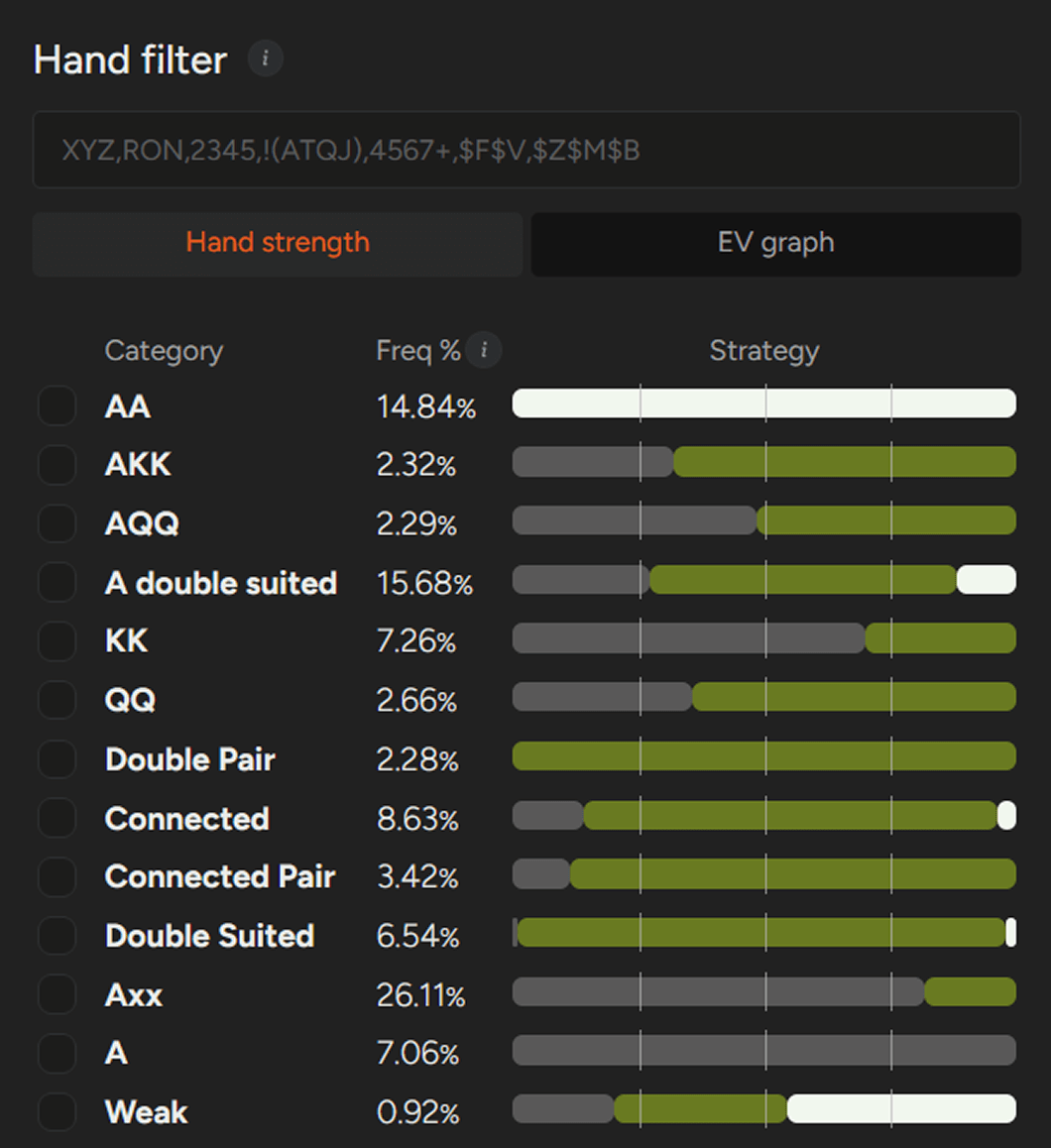
As we’ve discussed previously on our blog, when playing out of position at 100 BB, a strict rule of thumb is to 4-bet all AA combinations. This accomplishes several things at once:
- You build a pot while holding an equity advantage.
- You lower the SPR, simplifying postflop decision-making.
- You still have a chance to win the pot preflop.
When expanding beyond Aces, the few additional hands suitable for 4-betting from UTG are highly selective. The core candidates are:
- Well-connected double-suited Ace-high hands (e.g. AT98, A765)
- Connected double-suited gappers such as T976 or 9865
Perfect rundowns generally prefer calling rather than 4-betting.
One important thing to keep in mind is blocker interaction. When you’re 4-betting without Aces, it’s usually better to avoid hands with a King or a Queen, since they block AKK and AQQ — exactly the hands you’d like your opponent to have and fold.
Overall, UTG versus MP is a very tight spot. Even if both players follow GTO ranges, there isn’t much room to get creative here.
Against a UTG opening range of approximately 16.8%, MP should 3-bet around 5%, while UTG continues by 4-betting roughly 17.6% of its opening range (about 8,000 combinations out of 45,500), of which nearly 6,800 are AA combinations.
4-betting from the Cutoff against the Button
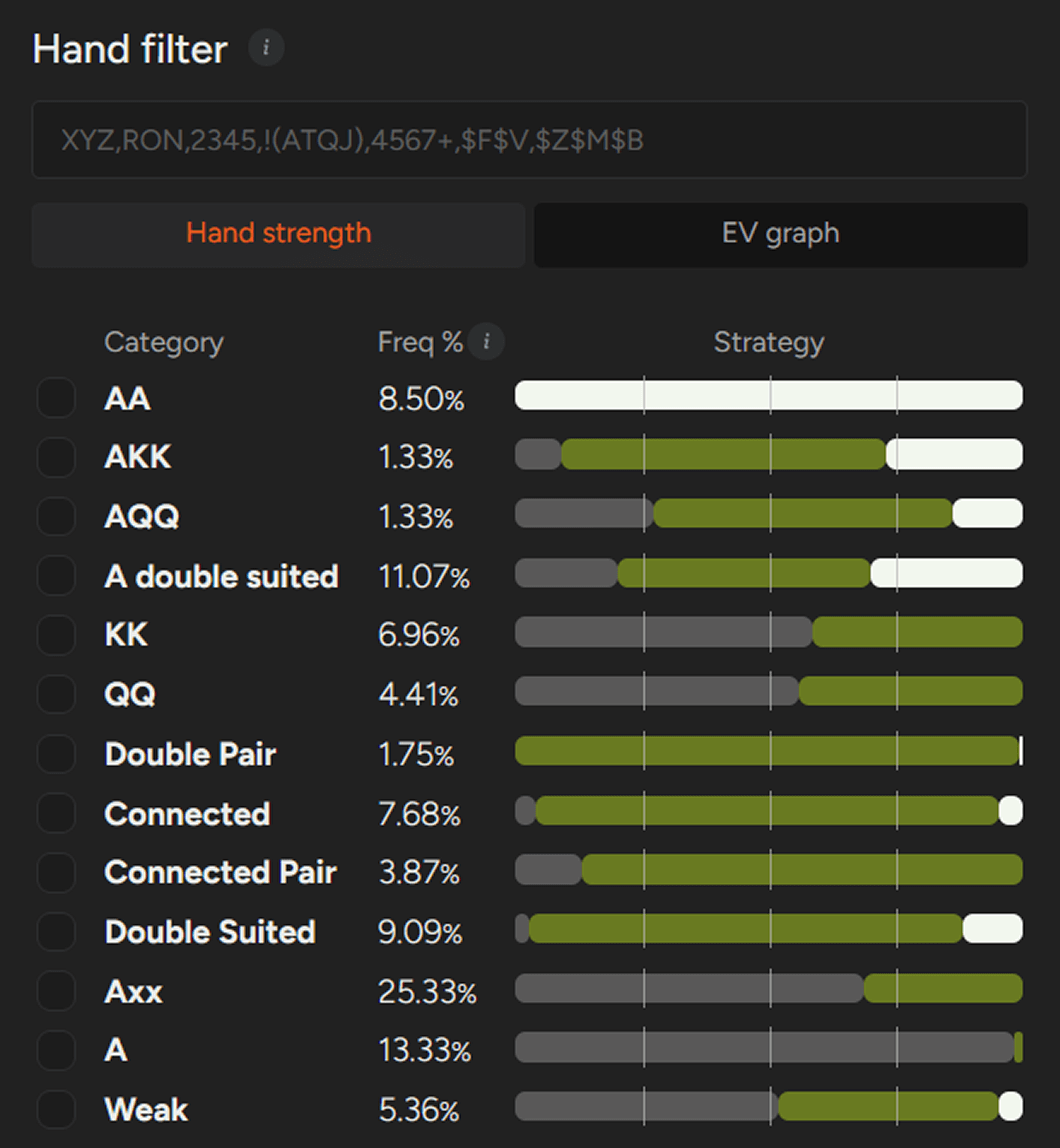
The Cutoff versus Button configuration is considerably more dynamic. Both ranges are much wider, and population tendencies tend to deviate further from a pure AA-only 3-bet strategy.
At equilibrium, the Cutoff opens roughly 29.4% of hands (close to 80,000 combinations), while the Button 3-bets around 7.8% (approximately 21,000 combinations).
As before, all AA combinations form the foundation of the 4-betting range for the same structural reasons outlined earlier.
The first meaningful difference appears in the AKK and AQQ categories. In this configuration, some of these hands — particularly premium double-suited versions like AKKQds or AKQQds — prefer 4-betting over calling. A small number of weaker Queen-heavy variants are also included, primarily because they block Aces and target folds from KK holdings.
The category that expands the most is double-suited Ace-high hands. These holdings:
- Reduce the number of AA combinations available to the Button,
- Maintain solid equity when called,
- Offer reasonable postflop playability.
Additionally, the CO vs BU dynamic allows for a wider selection of non-Ace double-suited hands to enter the 4-betting range, including holdings such as JT76 or QT86.
With wider baseline ranges on both sides, the Cutoff’s optimal 4-betting strategy becomes more diverse, especially when the Button is capable of folding a portion of their 3-bet range.
Practical Adjustments for Low- to Mid-Stakes PLO
While knowing the GTO baseline is useful, what really matters in practice are the tendencies of the player pool you’re facing. In low- to mid-stakes PLO, two patterns are particularly common:
- Players 3-bet slightly tighter than GTO suggests.
- Players fold less to 4-bets than theory would recommend.
At 100 BB, effective adjustments against this environment are relatively straightforward:
- Versus a Middle Position 3-bet, continue very tightly when opening UTG. You can largely restrict yourself to 4-betting Aces, with only occasional inclusion of the very best double-suited hands.
- Regardless of position, always 4-bet all AA combinations when out of position.
- Outside of the Cutoff vs Button configuration, avoid widening your 4-betting range with KK or QQ holdings.
As stack depths increase, optimal preflop strategies shift meaningfully — but that is a subject best reserved for a separate discussion.
At 100 BB, an effective 4-betting strategy in PLO remains relatively simple: heavily AA-weighted, with selective additions of strong double-suited hands and, in rare cases, high pairs containing an Ace blocker.
The key is knowing which hands actually belong in your 4-betting range — something you can easily check using the free 100 BB preflop solutions in PLO Genius.