Big Blind Preflop Strategy: Part 1 – Defending vs UTG Opens
How tight should you be when defending the Big Blind vs UTG in PLO? Tighter than you think.


A solid preflop plan is the foundation of every effective poker strategy.
That’s why you’ll find several articles on our blog about preflop play. We’ve already covered open-raising and defending against opens, as well as provided overviews of how to react in 3-bet and 4-bet scenarios. In this piece, we’ll complete the preflop game plan (at least for Heads-Up situations) by focusing on a basic but crucial spot with major postflop implications: defending the Big Blind out of position against an open raise.
Since this is a broad topic, we’ll divide it into two parts.
When you’re in the Big Blind, you’re almost guaranteed to have a negative win rate (except when facing only the Small Blind, which is relatively rare in most PLO games). Your goal, therefore, is not to turn a profit, but to lose less than you would by folding every hand, which would result in a win rate of -100 BB/100 hands.
The Overview of a Big Blind Strategy
Unlike the Small Blind, when you’re in the Big Blind and face a single raise, the optimal strategy leans heavily toward calling rather than 3-betting. Why is that?
From the Big Blind, you close the preflop action. This means you have full information — there are no players left to act behind you, so you don’t have to worry about squeezes. You’re also guaranteed to go heads-up, which simplifies postflop play.
As always in PLO cash games, the rake structure heavily influences your decisions. For the rest of this article, we’ll use the highest rake structure available in PLO Genius, which corresponds to PLO50. Before we dive deeper, it’s worth illustrating how the optimal strategy varies with both position and rake.
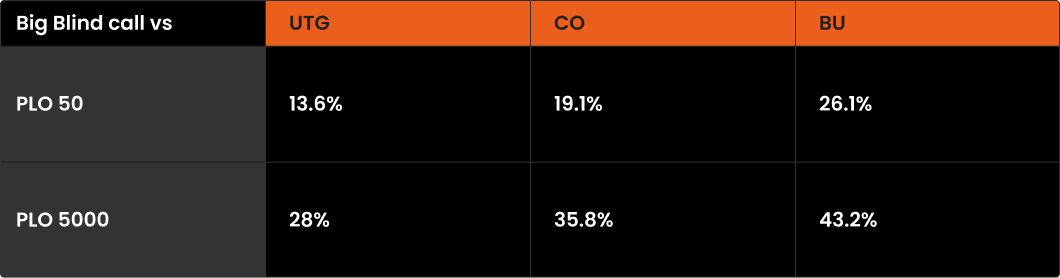
As you can see, the differences in responses across stakes are significant. Higher rake at lower stakes turns a large portion of calls (that would exist in higher-stakes environments like PLO5000) into folds at PLO50. This is an important takeaway: the higher the rake, the tighter you need to play preflop.
You can explore the impact of rake directly in PLO Genius using the Compare tool, which allows you to see how ranges shift under different rake assumptions.
Now that we’ve established the need for tighter preflop selection, let’s look at how to defend the Big Blind against a single raise at low stakes. As usual, we’ll examine two extremes: defending against UTG and against the Button.
In this part, we’ll focus on defending versus a UTG open at 100 BB. The second part will cover play against the Button.
Defending the Big Blind vs UTG
When defending the Big Blind against a UTG open at low stakes, you need to play tight — there’s no way around it.
You’re facing three major disadvantages:
- high rake
- a strong opening range (at least until proven otherwise)
- positional disadvantage
Together, these factors leave very little room for creativity.

Assuming UTG opens a reasonable range (which, according to theory, equals around 16.8%), you won’t be able to defend many hands profitably. In fact, the numbers are quite strict: you should fold 82.6% of your range, call only 13.6%, and 3-bet just 3.9%.
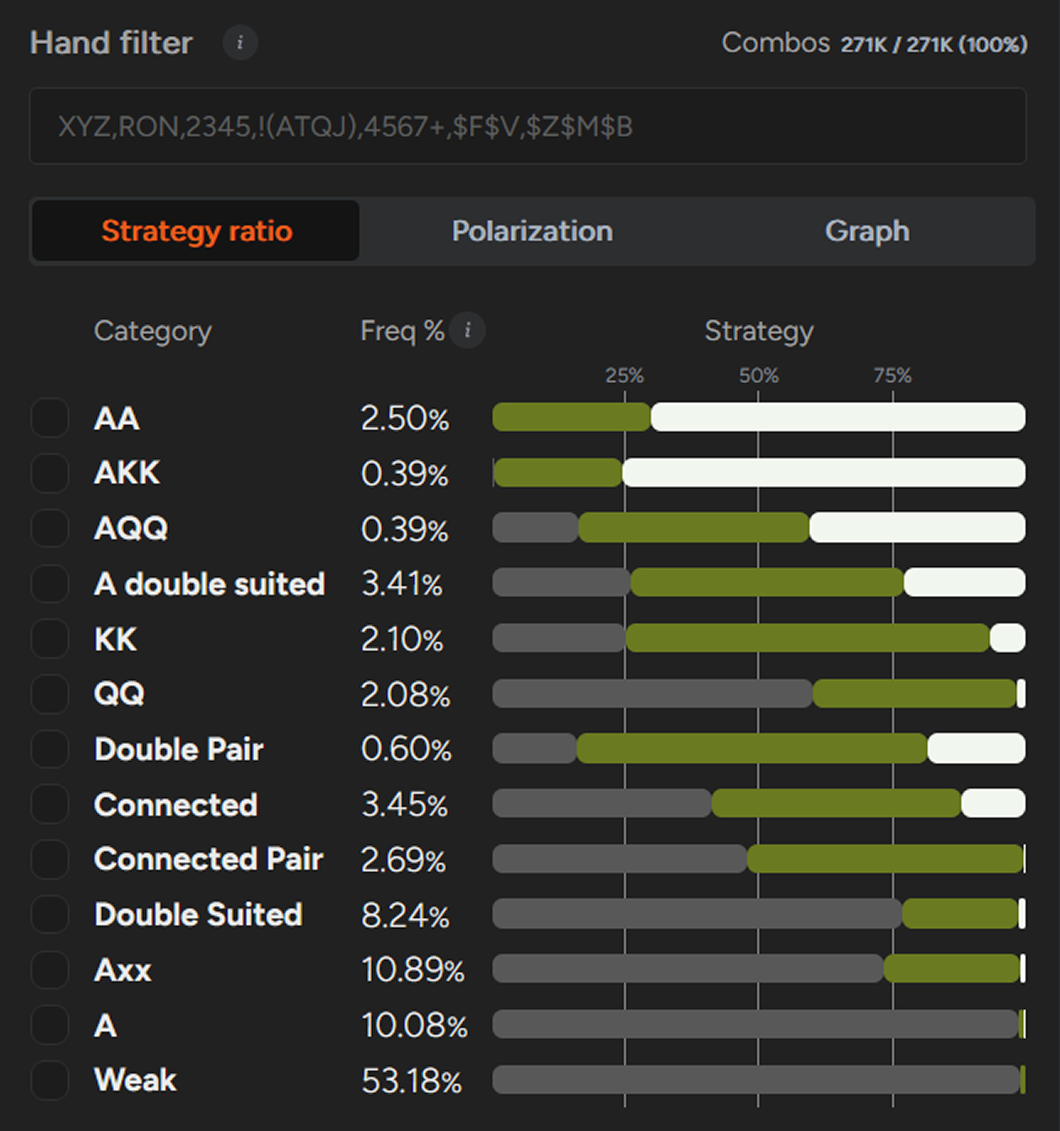
Here’s a broad overview of how your strategy should look.
Aces
Let’s start with everyone’s favorite hand: Aces.
When playing from the Big Blind against UTG, you should be cautious with your AA combos. Technically, 3-betting all AA hands would not be a mistake, since even the weakest combinations perform better as 3-bets than as folds. However, in practice, many poorly connected AA hands play much better as calls than as 3-bets.
Take AA92 tri-suited — one of the weakest AA combinations.
Its EV as a 3-bet is close to breakeven (around 0.03 BB), while calling yields a much higher EV (around 0.57 BB). Many similar hands flop poorly and often leave you with a bare overpair that cannot comfortably bet or call multiple streets.
Additionally, when your opponent calls your 3-bet, their range is typically strong enough to withstand pressure or apply it themselves. This puts you in difficult situations in bloated pots.
By calling with your weakest AA hands (as suggested by PLO Genius), you keep the pot smaller and maintain flexibility. You can fold more comfortably on unfavorable runouts without overcommitting.
At the same time, your opponent’s range remains wider, which improves your equity realization. You also underrepresent your hand, which can induce bluffs on Ace-high boards.
It’s also worth remembering that realizing EV is a skill in itself. The less playable your hand, the harder it is to extract its full value.
Overall, against a strong opening range, playing your weakest AA hands more passively helps avoid difficult spots and reduces unnecessary losses.
Kings & Queens
With Kings or Queens that include an Ace, your default strategy against a UTG open should be relatively aggressive. All AKK combinations are strong enough to continue at least by calling, with 75.6% of them suitable for a 3-bet. In the case of AQQ, only about 15% of hands are folded preflop, while 43.5% call and 40.6% are 3-bet.
However, keep in mind that even if you occasionally miss a 3-bet, the EV loss from calling is typically smaller than from incorrectly 3-betting a marginal hand.
For KK and QQ without an Ace, things change significantly — around 42.5% of combinations should be folded. This may feel counterintuitive, as folding Kings or Queens to a single raise often seems too tight.
At low stakes, however, this is the correct approach — especially for disconnected, rainbow, or tri-suited hands such as KsKdQc2h, KdKc8c2c, or QcQd7d4h.
If you defend too many KK and QQ hands in this spot, you’ll lose a lot of money over time.
Double-Suited Axx & Double-Paired hands
A more passive approach also applies to many double-suited Ace-high hands and double-paired hands.
First, about 26% of double-suited Ace-high hands are folded against a UTG open, which may be surprising given their perceived strength.
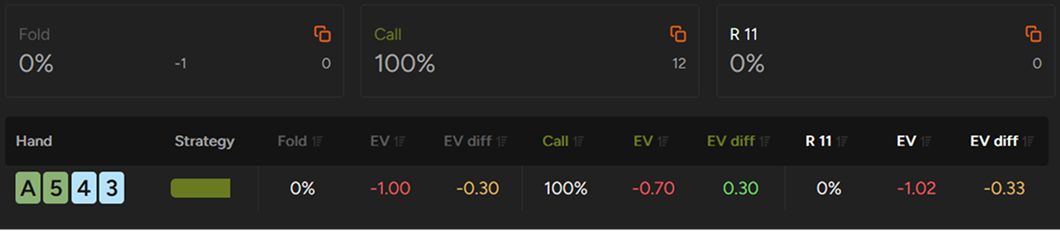
Second, these hands are often connected enough to tempt players into 3-betting too frequently. For example, Ac5c4s3s has an EV of about -0.7 BB as a call (still better than folding), but around -1.02 BB as a 3-bet. In other words, 3-betting performs worse than folding.
Similarly, with double-paired hands, you should avoid overplaying weak combinations. Low, disconnected, rainbow hands such as TT33, 9955, or JJ22 are folds.
That said, stronger double-paired hands generally perform well enough postflop to justify calling.
Connected & Connected Pair hands
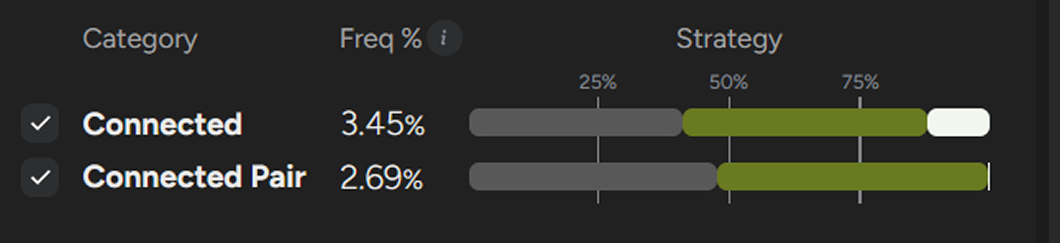
The next two categories — Connected and Connected Pair — are where things become more nuanced.
At first glance, many of these hands look appealing. They often have good structure, decent connectivity, and seem playable in heads-up pots. However, against a UTG open, their actual performance is much weaker than it might appear. Overall, you should still be folding around 44% of hands in these groups.
So how should you approach these hands in practice?
You should be very cautious with mono- and tri-suited hands — despite their apparent playability, they rarely perform well enough against a strong UTG range and are almost always folded.
Even well-looking rundowns lose much of their value when they consist of lower cards (below Jack), as they struggle against stronger, high-card-heavy ranges. Rainbow hands also tend to perform poorly unless they have additional redeeming qualities.
For example, hands like the T987 rainbow may look appealing, but should be folded against a solid UTG opening range. The same applies to JT87 with a tri-suit structure or 9887 tri-suited. In practice, however, many low-stakes players still defend all of these hands — a common population tendency you should be aware of.
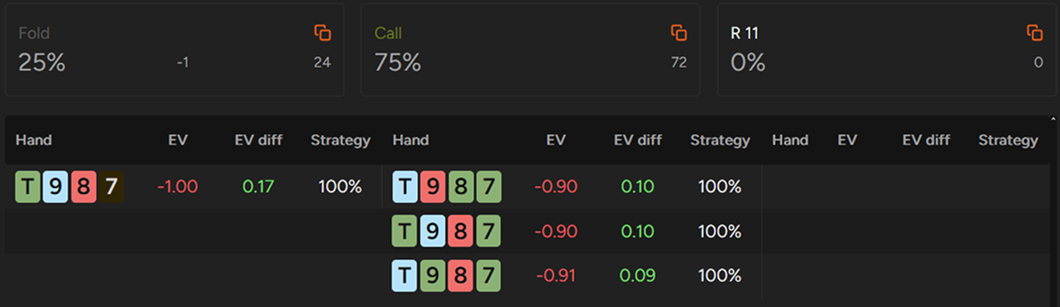
The same logic applies to lower connected hands: despite their appealing structure, they usually lack sufficient equity against a tight UTG range.
This category likely offers the most room for improvement, as many hands that feel playable are actually clear folds.
Double-Suited & Ace-High categories
In the Double-Suited and general Ace-high categories, you need to be extremely selective — around 83.2% of these hands are folds.
Examples of folds include:
- poorly connected double-suited hands like KcQc8d3d, Jc9c4d2d, or KcTc7d2d
- disconnected Ace-high hands (even with a pair or a suit), such as AdTd6c6h, AcKcQc9d, or AcJd5c3h
- most tri-suited or non-nut-suited Ace-high hands
Weak hands
Finally, there is a large group of weak hands that don’t fall into any of the above categories.
These make up over 53% of all starting hands (around 144,000 combinations), and more than 99% of them should be folded against a UTG open.

Defending the Big Blind Properly Is Worth the Effort
Defending the Big Blind against a UTG open is more complex than it might seem.
Many hands look tempting to call, but their expected value doesn’t support it. If you defend too wide, you will lose money — it’s that simple.
The good news is that this is a fundamental area where many players still make mistakes, creating opportunities for improvement.
That’s where PLO Genius comes in, helping you build intuition for these situations and identify the hands that cost you money.
That’s it for part one. In the next article, we’ll look at the other side of the spectrum: defending the Big Blind against a much wider (and weaker) Button range.