How to Defend vs 3-Bets Out of Position in Pot Limit Omaha
Let’s look at how solvers approach defending against 3-bets out of position in Pot Limit Omaha.


The popular saying goes: “A penny saved is a penny earned.” This principle applies to poker just as much as it does to everyday life.
Many poker players naturally focus on their biggest pots — typically those where stacks go in and the hand ends in a showdown after a difficult decision or a cooler. While such spots have a significant impact on your win rate, becoming a truly solid player also requires identifying situations where you may be leaking small amounts of EV repeatedly.
In Pot Limit Omaha, one of the most common sources of these leaks is poor play in 3-bet pots out of position. More precisely, inefficient reactions to 3-bets. The lack of position in PLO is a disadvantage that is notoriously difficult to overcome, and playing 3-bet pots OOP with poorly constructed ranges will be challenging even against relatively inexperienced opponents.
In this article, we will focus on the most important do’s and don’ts when facing 3-bets out of position.
Theoretical 3-Betting Frequencies
To establish a baseline for OOP strategy in 3-bet pots, we will examine two common scenarios:
- Opening in the Early Position and facing a 3-bet from the Cutoff
- Opening in the Cutoff and facing a 3-bet from the Button
We will assume a high-rake environment equivalent to PLO 50. It is worth noting that while optimal 3-betting frequencies do not increase dramatically at higher stakes (e.g. PLO 5000), calling frequencies do.
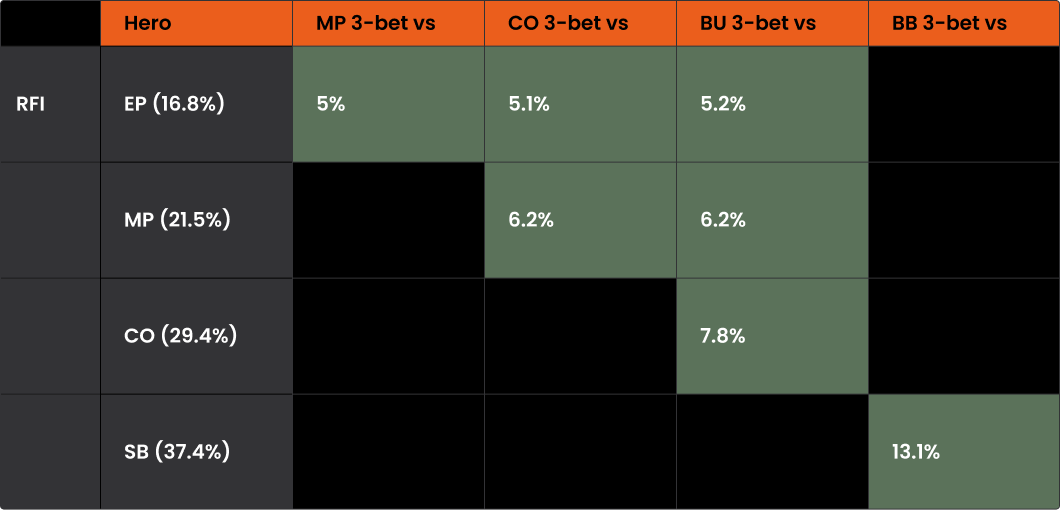
As we've discussed in the article about 3-betting in position, these solver-derived frequencies should be treated as a theoretical baseline. In practice, real opponents deviate significantly from optimal play — most commonly by 3-betting less frequently and with ranges that are heavily weighted towards AA, especially at PLO50 and below.
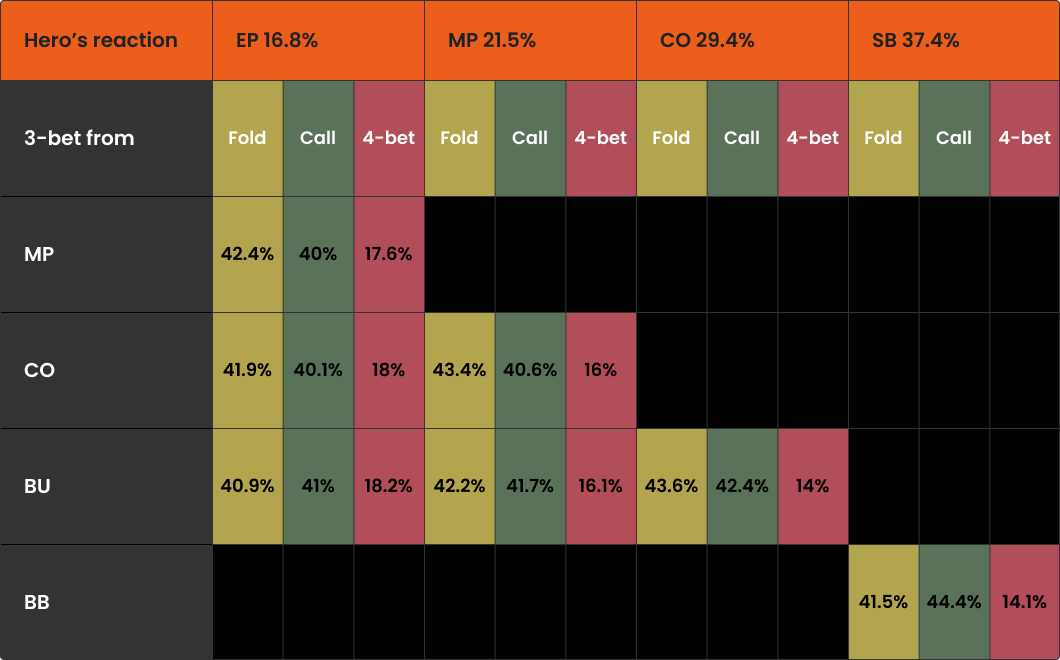
For now, however, we will stick to a Game Theory Optimal framework and examine how solvers suggest reacting to 3-bets when out of position.
Now, let’s compare these frequencies to situations where we are in position and face a 3-bet from the Small Blind.
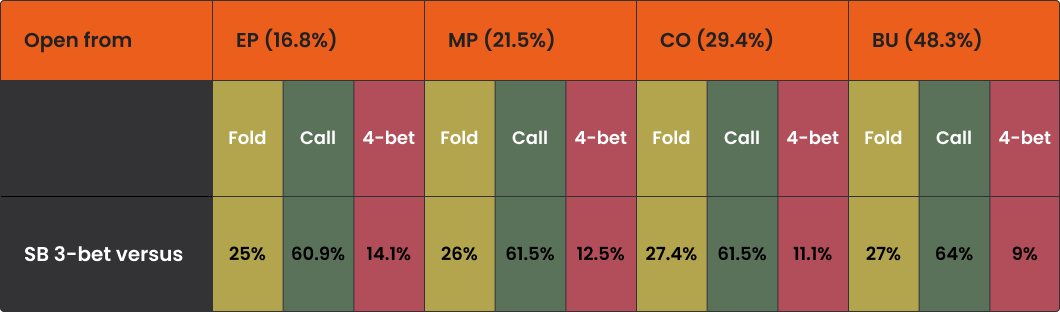
Several intuitive conclusions to note are:
- When out of position, we should call less often.
- The lack of position forces us to fold more frequently to avoid difficult postflop situations with poor equity realization.
- At the same time, we are incentivized to 4-bet more often, both to deny equity and to simplify postflop play when called.
As always, rake is a factor, particularly when it comes to calling frequencies, as it disproportionately penalizes marginal OOP calls.
How to react against 3-bets when you’re out of position?
Now, let’s take a closer look at what a solid baseline strategy should look like for the main hand categories when you open and face a 3-bet from a player in position.
We will start with an Early Position vs Cutoff scenario at 100 BB, where the solver continues with a 40% calling range and a 17.6% 4-betting range, for a total of roughly 26,000 combinations.
Here's an overview of the most relevant hand categories:
AA
The strategy for Aces facing a 3-bet out of position is as straightforward as it gets — 4-bet 100% of your AA combinations.
KK
This category does not contain any pure 4-bets.
- you should continue with all AKKx combinations that include a suit to the Ace.
- all double-suited Kings continue, with the exception of the very weakest ones.
- when single-suited, look to continue only with double-paired Kings or the very best single-suited holdings (such as KKQT).
QQ
This category becomes more nuanced.
- all double-suited AQQx combinations continue.
- single-suited Queens require a suit to the Ace and an additional card that can form straights with either the Ace or the Queen.
- Queens without an Ace must be either double-suited, double-paired, or supported by strong side cards (e.g. QQJT) to continue.
Double-paired hands
If a double-paired hand is strong enough to be opened from the Early Position, it continues versus a 3-bet.
Double-suited hands
This is definitely the most challenging category.
- an Ace often becomes a liability against AA-heavy 3-betting ranges, as it reduces the likelihood of making strong two-pair hands. As a result, double-suited Axxx combinations generally require either a pair or strong connectivity to continue.
- unlike higher paired categories, this group contains a meaningful number of 4-bets (approximately 13.7%), primarily made up of the best connected combinations.
- double-suited hands without an Ace continue almost exclusively as calls, as these hands are strong enough opens to perform well even in 3-bet pots.
Now, let’s look at how the strategy changes when defending from the Cutoff against a Button 3-bet.
In this configuration, the solver recommends continuing with 56.4% of your range, split into 42.4% calls and 14% 4-bets. In absolute terms, this corresponds to roughly 33,000 calling combinations and 11,000 4-betting combinations. It is important to keep in mind that the Cutoff opening range is significantly wider, so despite similar percentages, you are defending a much larger number of hands in practice.
Let's look at an overview of the CO vs BU strategy by hand category:
AA
As in the EP vs CO scenario, all Ace combinations are pure 4-bets.
KK
Here the strategy changes slightly compared to the Early Position.
- from the Cutoff, you open much wider with Kings and end up folding roughly 50% of those holdings.
- unlike in the EP strategy, some AKKx combinations become 4-bets, while almost all single-suited Kings (and better) continue as calls versus a 3-bet.
QQ
Queens behave similarly to Kings at this positions.
- a small portion of AQQx combinations (around 3.2%) prefers to 4-bet. These hands target folds from parts of the opponent’s KK-heavy range; they have strong raw equity but are vulnerable on many flops.
- aside from these, nearly all double-suited Queens and those with reasonably connected side cards continue as calls.
Double-paired hands
As in the previous scenario, all double-paired hands that are strong enough to open are also strong enough to continue by calling.
Double-suited hands
Once again, this is the most complex and interesting category.
- when your hand contain an Ace, all three options are in play.
- approximately 20% of combinations with an Ace are folded — primarily hands with poor connectivity and low danglers, such as AK83 or A982.
- about 50.1% continue as calls, consisting of paired or reasonably connected holdings like AJ44 or AKT3.
- the remaining 29.9% are played as 4-bets, mostly the best connected combinations, such as AT87 or AT98.
- double-suited hands without an Ace continue at very high frequency: 85.7% as calls and 11.7% as 4-bets, with only 2.7% of combinations folding.
Practical Considerations
While solver outputs provide an invaluable theoretical foundation, it is crucial to remember that you are playing against human opponents who often deviate significantly from GTO.
Most player pools 3-bet less frequently than optimal and do so with ranges that are heavily skewed toward AA. This reduces the profitability and playability of hands such as double-suited Ace highs.
As a result, when in doubt with a marginal combination, folding is often the correct exploitative adjustment — especially if you expect your opponent to 3-bet tightly and play straightforwardly.
Finally, keep in mind that many solver-recommended 4-bets rely on the assumption that your opponent will fold part of their 3-betting range, particularly weaker KK combinations. Against players who never fold to 4-bets when in position, aggressive 4-betting without premium holdings loses much of its appeal.
Hopefully, this article has helped clarify the strategic considerations involved in defending against 3-bets out of position in PLO. For further insights, consider visiting our articles on 3-betting in position and reacting to 3-bets when in position.
If you would like to explore these spots in more detail, the PLO Genius app offers an extensive library of preflop solutions, including a solid selection available for free, with additional depth in higher plans.