How to React to 4-Bets in PLO
How to react against AA-heavy 4-betting range?


In our recent blog posts, we discussed 3-betting strategies (both in position and out of position), optimal reactions to 3-bets (once again, in position and out of position), and general guidelines for 4-betting.
This article completes the series with a straightforward guide on how to respond when facing a 4-bet in Pot-Limit Omaha.
As we established in earlier entries, at low- to mid-stakes, you should assume that the population 3-bets and 4-bets significantly tighter than GTO solutions suggest at 100 BB effective stacks.
While many players are capable of finding non-AA 3-bets, their 4-betting ranges are often heavily skewed toward Aces and, in many cases, almost exclusively composed of AA combinations.
Because of this, every time you face a 4-bet, several factors should guide your decision-making process.
First, consider how your own 3-betting range is perceived. Are you seen as a tight, value-oriented player, or as someone capable of applying pressure with a broader range?
Second, assess whether your opponent is capable of 4-betting hands other than AA. This is where paying attention to showdowns and population tendencies becomes especially valuable.
Finally, you should have a clear plan for how to adjust when facing a range that is overwhelmingly AA-heavy.
As in earlier articles, we will examine two common positional scenarios.
Facing a UTG 4-Bet When You Are in the Middle Position
This configuration produces the tightest ranges. According to GTO frequencies (assuming a PLO50 rake structure), UTG opens approximately 16.8% of hands (~45k combinations), MP responds with 3-betting around 5% of hands (~13.5k combinations), and UTG continues with a 4-bet roughly 17.6% of the time (~8k combinations).
When we examine these 8k combinations more closely, nearly 7k of them contain either a pair of Aces or triple Aces. This immediately frames the problem: how should MP react against such a narrow, AA-heavy range?
While PLO Genius solutions suggest calling a small portion of AA hands in MP (around 4.1%), we recommend a simpler, more practical adjustment: 5-bet-jam all AA combinations. Aside from Aces, no hands are incentivized to go all-in preflop in this node, making execution straightforward. From the remaining non-AA hands in your 3-betting range, approximately 30.1% continue versus the 4-bet by calling.
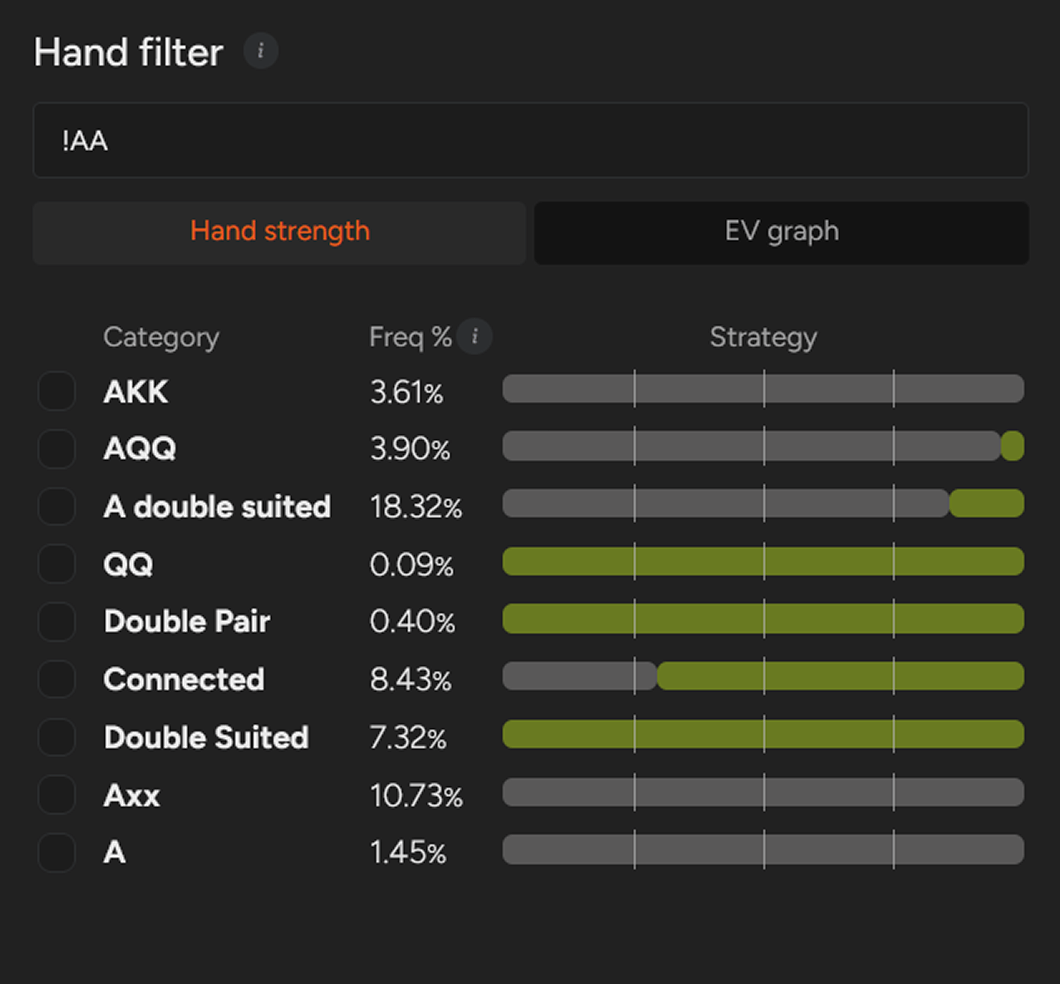
Notably, no Kings continue against a UTG 4-bet. KK without an Ace does not 3-bet versus a UTG open in the first place, and KK with an Ace folds at this point. Moving down the range, the only Queen combinations that defend by calling are AQQJds and AQQTds.
For double-suited Ace-high hands, the requirement to continue is strong connectivity: typically no more than one gap, with side cards between a Queen and a Six (for example, AJT9ds or AT87ds).
This structure leads to an essential strategic takeaway: holding an Ace against a highly AA-heavy range is often a liability. It reduces your ability to make strong two-pair hands and weakens overall connectivity, which strongly impacts which hands can profitably continue against a 4-bet.
The backbone of your calling range in this scenario consists of highly connected double-suited hands that were strong enough to 3-bet against UTG, such as 9765ds, T876ds, or 7654ds. These hands retain solid equity against AA-heavy ranges and flop in a way that makes postflop play more manageable.
In addition, a small number of double-suited paired hands (including a few Queens combinations) round out the MP calling range versus a UTG 4-bet.
Facing a CO 4-Bet When You Are on the Button
In this configuration, the out-of-position player’s ranges widen considerably — the Cutoff 4-bets roughly 14% of its opening range, corresponding to approximately 11k combinations. Similar to 3-bet scenarios, this gives the Button substantially more flexibility.
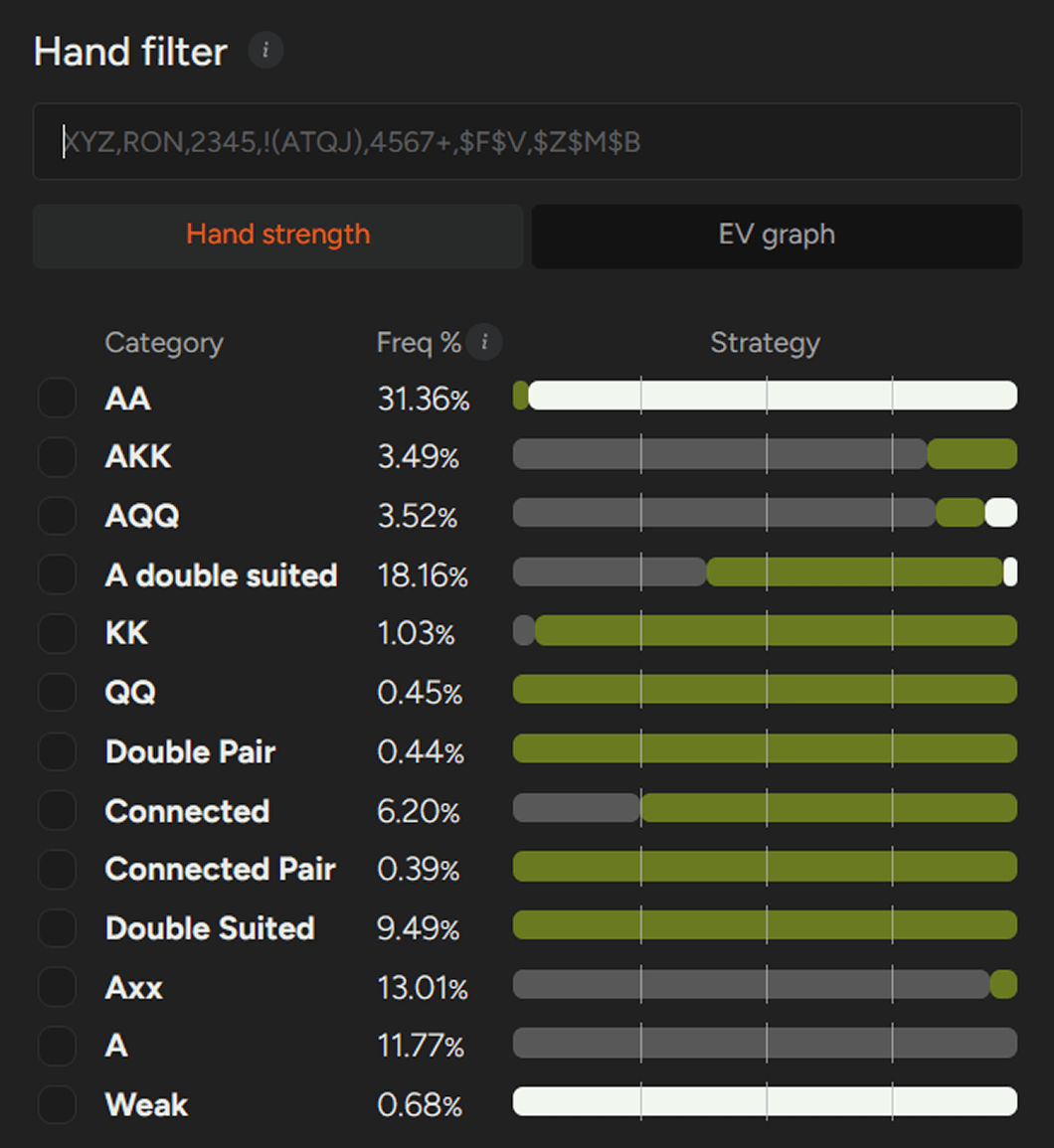
Once again, the primary guideline remains unchanged: all AA combinations should be 5-bet jammed.
At 100 BB effective stacks, there is rarely a strategic reason to slow-play Aces. Against a Cutoff 4-bet, the Button shoves 6.7k combinations preflop, with approximately 99% of this range consisting of AA.
At the same time, the Button’s overall calling range versus a CO 4-bet expands significantly to around 6.2k combinations, compared to only 2.5k combinations in the MP versus UTG scenario.
So which hands gain value in this late-position dynamic?
First, both Kings- and Queens-based hands increase dramatically in viability and approach near-pure calls. It is worth noting, however, that only a relatively small subset (roughly 300 combinations) of these hands should be 3-bet versus the CO in the first place.
Some double-suited KK hands containing an Ace have sufficient equity to call, and the same is true for select QQ combinations with an Ace. A few AQQ hands even function as 5-bet jam bluffs, targeting folds from KK in the CO’s range. However, if you believe your opponent never 4-bet/folds, these hands can instead be shifted toward calls.
Because the CO’s 4-betting range includes a meaningful portion of non-AA hands, the Button can profitably call more double-suited Ace-high combinations. Hands such as AKQTds or AK54ds improve substantially in value under these conditions.
Against a wider 4-betting range, all strong double-suited and double-paired hands become viable calls, as they realize equity efficiently in position. However, the same principle from the earlier scenario still applies: having an Ace often weakens your hand, and in many borderline cases, it becomes the deciding factor between calling and folding.
Overall, the BU versus CO dynamic allows the Button to continue with a broader range due to the increased presence of non-AA hands in the Cutoff’s 4-betting strategy.

Handling 4-Bets at 100 BB Is More Straightforward Than You Think
Overall, dealing with 4-bets at 100 BB is much more manageable than it may seem. You do not need to spend much time memorizing exact frequencies to navigate these spots effectively; what matters most is understanding the nature of the range you are dealing with.
In practice, most low- and mid-stakes opponents arrive at 4-bet nodes with significantly more AA combinations than they should, and this population tendency should always be reflected in your decisions.
To build and verify this intuition efficiently, use PLO Genius when studying or reviewing hands. We’ve recently added an equity calculator feature, which lets you quickly evaluate how specific hands perform against different AA-heavy combinations, making it much easier to determine which calls in 4-bet pots are actually justified.