How Wide Can You Open Preflop in PLO?
How wide should you really open in PLO — and what influences that decision?


Pot Limit Omaha is primarily played in the cash game format, whether we talk online or live. Due to the nature of the game, players often get very deep (especially in live games), with stacks counted in hundreds of big blinds. Crazy dynamics, plenty of big pots, and loose players are signs that you are at the right table. Such PLO games are not rare and offer great opportunities, but they also require great discipline and an understanding of your game plan.
Deep stacked poker is often complicated and challenging, so to make the most of it, you have to adjust accordingly. One of the basic but most essential adjustments is making sure you are opening the proper ranges.
Many players fall into the common pitfall of loosening their opening ranges because other players also open loose. As a result, chips fly left and right.
A simple but accurate methodology for evaluating your hands preflop is to consider nuttiness, connectedness, and suitedness. You should also account for the impact of rake, especially if you play mostly online.
Additionally, check out a few essential tips for playing Aces, Kings, and other high pairs in other articles on our blog.
Why Position Matters in Poker (Including Pot Limit Omaha)
By now, you should be perfectly aware of that. The more players in the hand have a positional advantage on you, the less information you have at your disposal, and the harder it will be to realize your hand's expected value. This is true at every point of every hand, and the importance of the position starts preflop, which you should always have in mind.
The most important consequence is that the earlier your position is, the tighter your opening range should be. What you should consider before opening a hand on each position
Early Position and Middle Positions
When creating game theory optimal ranges, solvers assume that other people will react correctly to your opens, so all ranges are prepared for equilibrium — in which pots with three, four or more players are very rare.
If you have experience with low and mid-stakes Pot Limit Omaha, you know that multiway pots happen very often. Multiway pots (especially when deep stacked) can be tricky to navigate, and they get even more complex when multiple players have positional advantage over you.
You should remember that whenever you're on EP or MP. Your opponent will almost certainly be cold-calling too much, which should affect your game plan (by too much, we mean significantly more than the GTO strategy assumes). Naturally, you can exploit this tendency, but first, you must adjust your preflop ranges.
If you take a look at GTO frequencies provided by PLO Genius, you'll find out that against an EP open, the GTO should more or less look like this (let's take a low stakes rake structure, 100 BB into consideration):
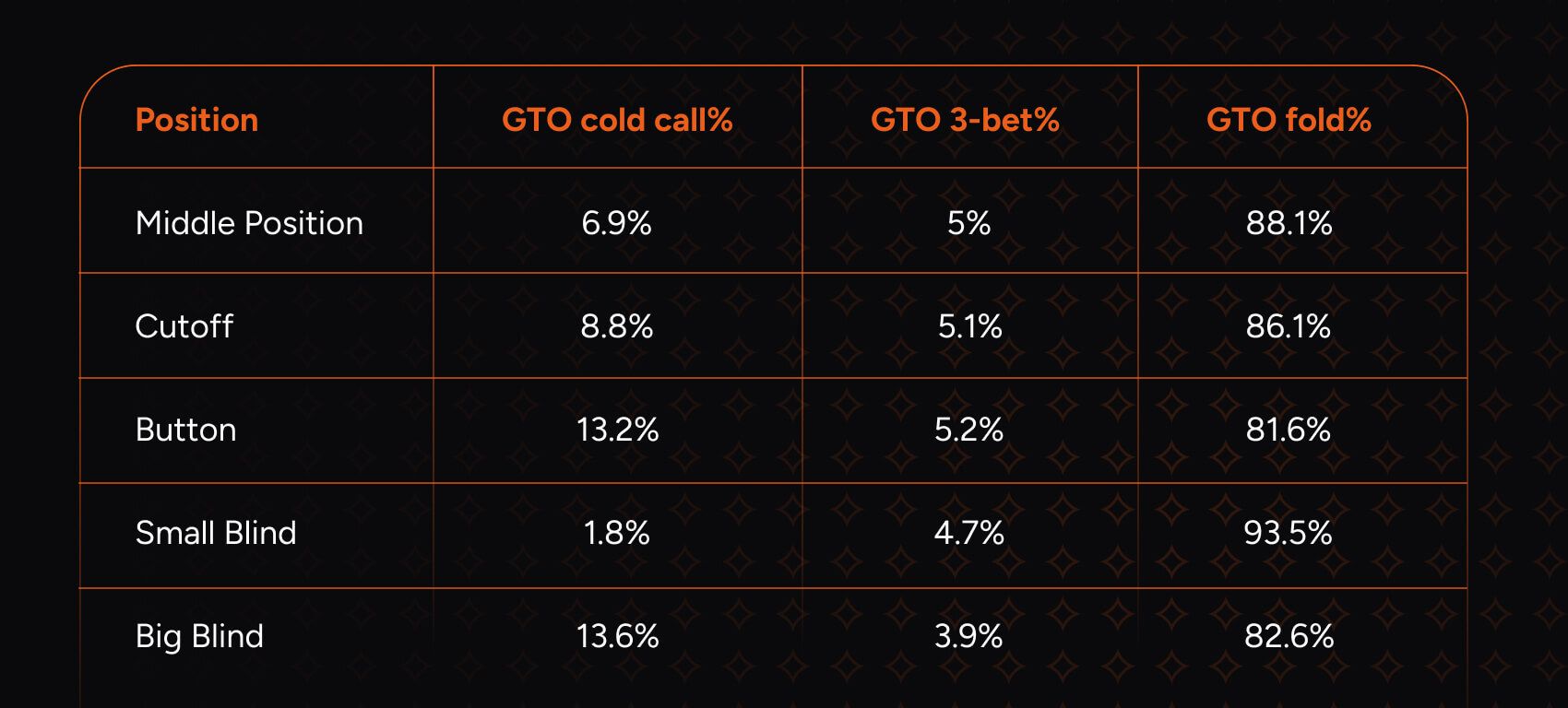
If you play against GTO-aware opponents, they will cold call rarely and 3-bet around 5% of the time. Also, notice that the Small Blind should almost never call your UTG open, and the Big Blind should defend by calling less than 14% of the time.
If you have a database gathered by tracking software, you can compare these values with what happens in your games. Even if you don't possess such data, you probably will agree that cold calling occurs much, much more often than it should, according to theory.
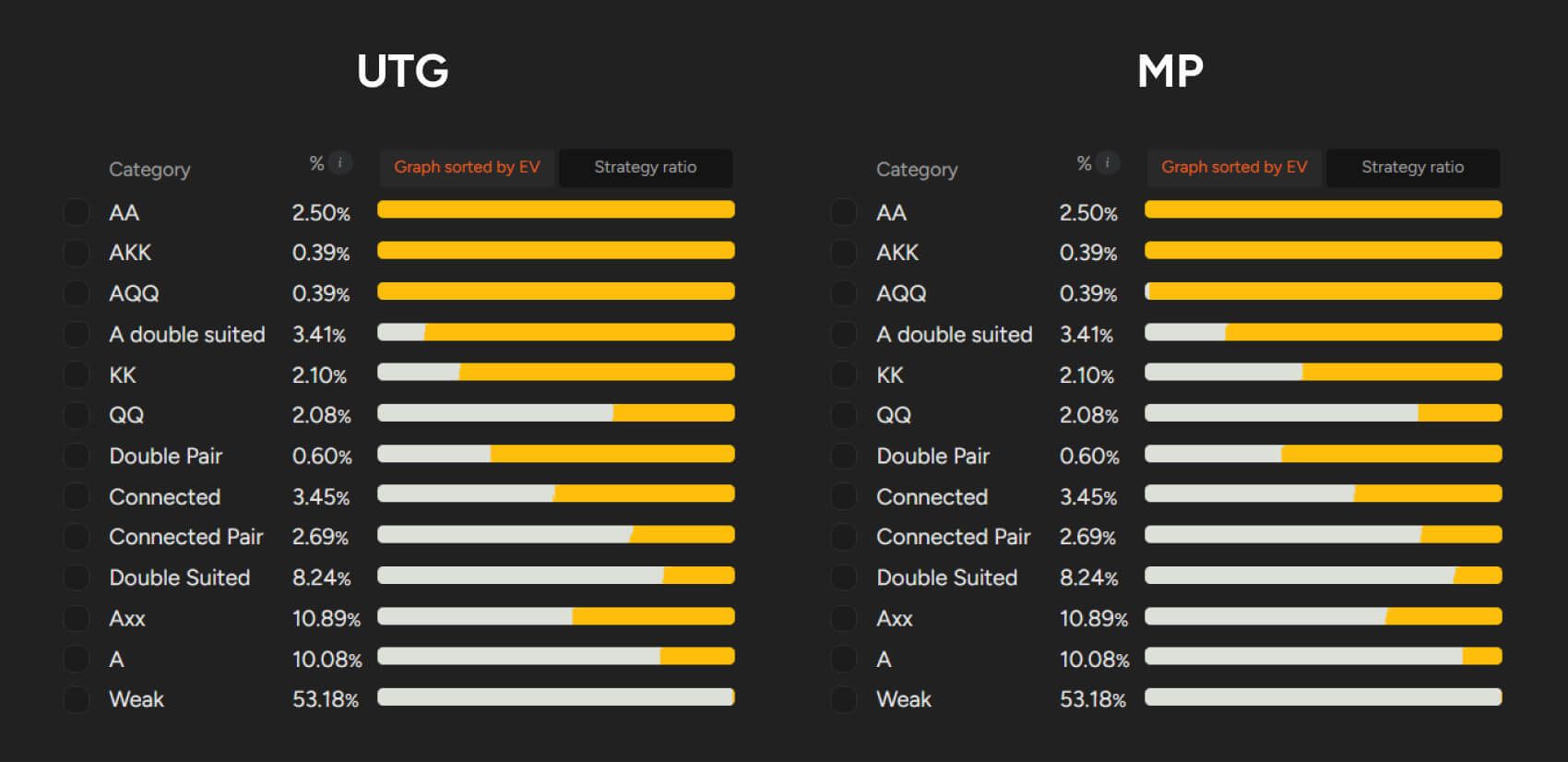
What's the takeaway? Whenever you're in the Early or Middle position, you should be very selective about the hands you open and skip opening the worst GTO-approved but the lowest EV hands. You won't be able to turn them into profit, and they will likely get you into very complicated yet avoidable situations.
Don't forget that the more players can enter the pot, the more significant role reversed implied odds may play postflop.
When you want to learn which hands should be and should not be in your range, dividing them into categories is an efficient study method. You'll be doing fine as long as you know the bottom of your range in a particular category. Remember what we've underlined earlier — to let go of the worst-performing combos. If low-to-mid stakes are your bread and butter, the fold is usually the way to go if you consider opening a hand while in EP or MP.
In other words, if your hand performs poorly out of position postflop — ditch it. An excellent tool to get some more understanding of how certain hands play EV-wise is ProPokerTools, which you can get here.
Here's how our solver would approach opening on EP and MP to give you a rough estimate.
Things Change in the Cutoff
The Cutoff is the first position, which grants you more freedom when it comes to opening hands (and this remains true whether you play the classic online six-max or eight-max live games). Whenever you're on the Cutoff, only one player can have a positional advantage over you and whose tendencies you should be concerned about — the Button.
As a result, your strategy should rely heavily on the player who sits on your left. The happier they are to VPIP (whether by cold calling or 3-betting), the more cautious you should be.If they are on the tighter side, the more closely you can follow the GTO ranges; after all, even if the blinds are out of line, you'll have a position on them.
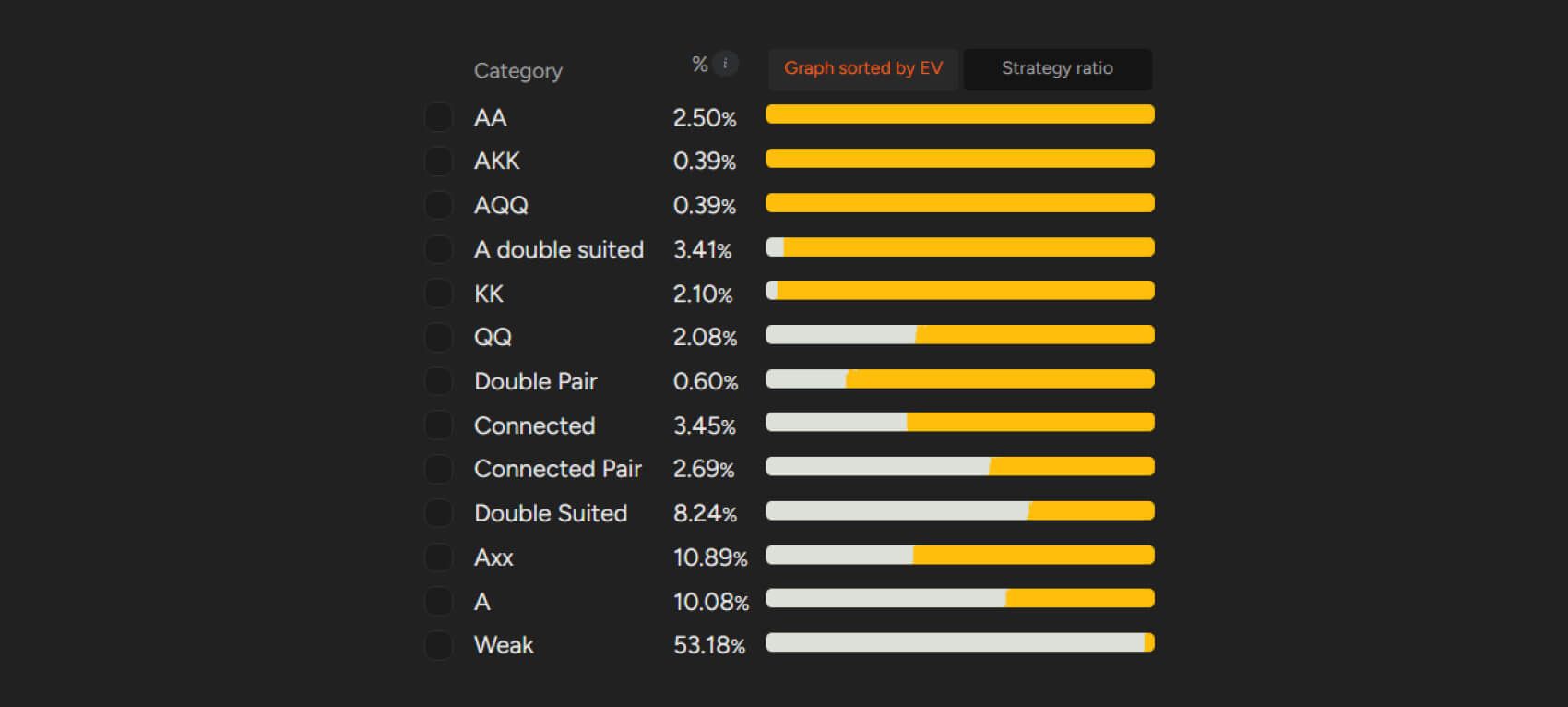
Under the same assumptions we’ve made earlier the GTO opening range for CO is around 29% and looks like this:
Additionally, it's worth noting that if you have a database available you can check in real-time how often:
- Button cold call/3-bet versus CO
- Small Blind and Big Blind fold versus a steal
These stats will help you adjust your opening ranges to your current opponents.
Playing from the Button: Always in Position
It is one of the most significant advantages in poker — and it becomes even more important in deeper-stacked games. This is also reflected in win rates, as the Button is typically the most profitable position at the table.
Having guaranteed position allows you to open quite liberally when first to act. With only two players left to act behind you preflop, and the certainty of playing every postflop street in position, you can take full advantage of your edge.
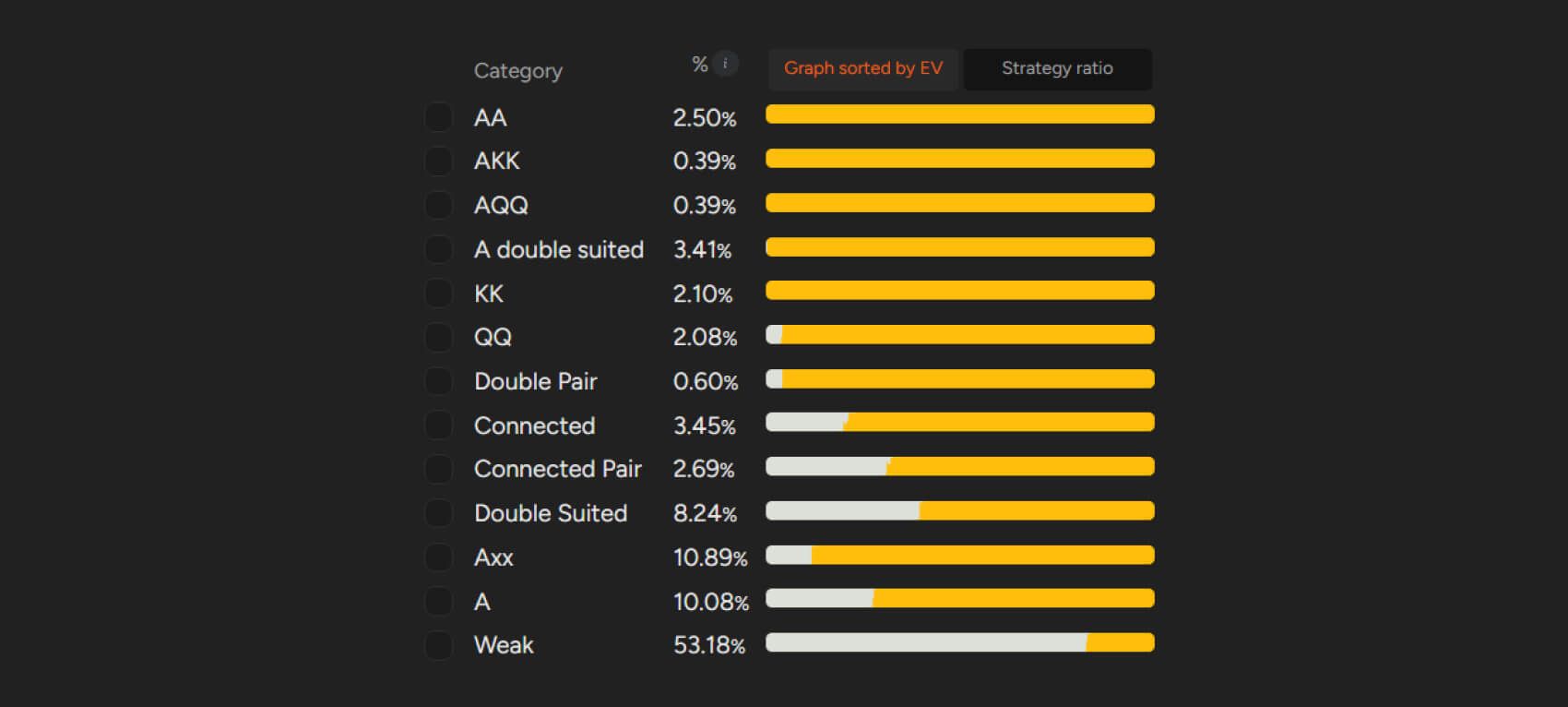
That's why the BU is where you can be closest to the GTO opening frequency, which, under the adopted circumstances, equals roughly 48%.
You can even go wider with open if you find yourself against overly tight preflop blinds (meaning they overfold against a raise) or postflop (they overfold to c-bets). Such opponents will be rare on low-to-mid stakes, but you're guaranteed to encounter them occasionally, and you better be prepared to spot them because…
Winning the Pot Preflop Matters More Than You Think
But at the same time, it happens much less frequently than it should.
According to the theory, whenever you open Under The Gun on a six-handed table, you should win the pot uncontested around 50% of the time. The exact percentage of how often this happens at your games will vary, but we're pretty sure it will be much lower (the lower the limit, the less often you'll win a pot preflop).
What's important is that whenever you take a pot down preflop, you win 1.5 BB. It seems like a small gain, but when converted to a standard win rate metric — Big Blinds per 100 hands — we get 150 BB/100, which is nearly impossible to achieve over any representative decent sample of hands.
For context, winning everything over 5 BB/100 on mid or high stakes is an excellent result.
So you should, on the one hand, open very tight when in earlier positions to avoid playing multiway OOP and, at the same time, identify spots where you are likely to win blinds easily when in late positions.

Your Win Rate Starts Preflop
Perfecting your preflop ranges is well worth the time; it will save you a lot of headaches caused by unnecessary and troublesome spots and allow you to create many favourable situations against less experienced and impatient opponents.
That's why we strongly recommend studying with PLO Genius and testing what you learn with its GTO trainer functionality — you'll improve your PLO preflop skill in no time.