Poker Tools to Improve Your PLO Skills!
Improving in Pot Limit Omaha requires more than intuition. Here are the tools that can help you.

Like in No Limit Hold’em, poker tools and software are essential — if not necessary — for becoming a better player. Since Pot Limit Omaha is more complex and harder to visualize, developing effective tools is more challenging, but far from impossible.
In this article, we’ll look at three of the most valuable types of poker tools for players aiming to improve their PLO game.
Equity Calculators
There’s no way around it — understanding equity in PLO is one of the most important skills you can develop. Using an equity calculator in Pot Limit Omaha helps you build that intuition much faster and with far greater accuracy.
Equity distribution in Pot Limit Omaha is highly nuanced and varies significantly across different scenarios, which is why learning how to estimate it is so valuable. Tools designed for PLO allow you to quickly compare hands, visualize equity splits, and better understand how different combinations perform against each other.
For example, in No Limit Hold’em, the equity of Aces is relatively stable and typically hovers around 80% against a random hand. This is not the case in PLO, where suits and side cards drastically affect both the strength and playability of AA hands.
Across all AA combinations (including trip Aces and quads), the average equity versus a random hand is around 65%. When we narrow it down to a weak holding like AA72 rainbow, the equity drops to just over 61%. On the other hand, a premium hand like AAJT double-suited can reach around 70% equity.
By regularly working with an equity calculator, you’ll start to recognize these differences instinctively — which translates directly into better decisions at the table.
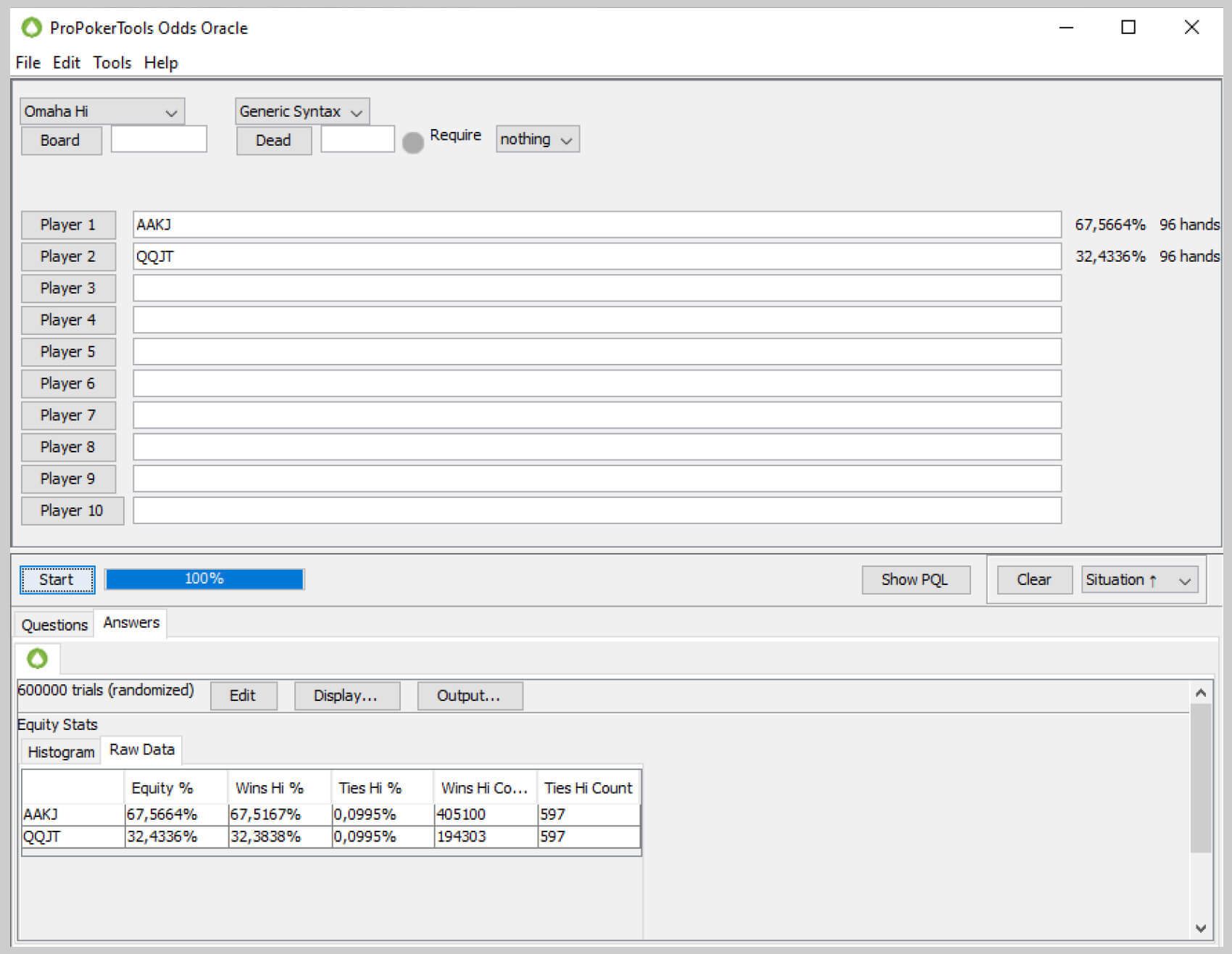
As you can imagine, this is just one of many possible scenarios — and equity calculators help you understand how different hand classes perform against each other. While preflop equity is less decisive in PLO than in NLH due to the pot-limit structure, it still provides a useful baseline. Just like in Hold’em, you can also use an equity calculator with community cards added to analyze specific postflop situations.
Given the vast number of possible starting hand combinations, their interaction with different board textures, and the ranges of other players, the number of relevant scenarios grows rapidly. Memorizing all of them is virtually impossible — which is why working with an equity calculator is so valuable. Over time, it sharpens your intuition and improves your ability to estimate equity in real time.
Popular tools like PokerStrategy Omaha Equilab and Poker Pro Tools are great starting points. At the time of writing, the latter is available for free and even supports other formats, including Omaha Hi-Lo, Five Card PLO, and Six Card PLO.
Tracking Software
Poker is a mix of math and psychology, and Pot Limit Omaha is no exception. While software won’t do much for the psychological side of the game (aside from mindset-focused tools), it plays a huge role when it comes to analyzing the numbers behind your decisions.
Where equity calculators help you understand how different hand classes perform, tracking software allows you to take a much deeper look — including how your own game actually looks in practice.
So how does it work? A poker tracker stores all the hands you’ve played in a database and converts them into a heads-up display (HUD), turning raw hand histories into clear, actionable statistics for both you and your opponents.
With this data, you can start asking the right questions: Are your opening ranges close to optimal? Do you 3-bet often enough? Are you defending correctly against 3-bets? Are you over c-betting? Tracking software gives you the tools to find these answers.
As your database grows, the analysis becomes even more powerful. You can review specific lines — for example, how often you follow up with a river bet after check-raising the turn, or how profitable your river calls actually are.
If you regularly play against the same opponents, tracking software also allows you to identify their tendencies over time — what they do well and where they might be leaking.
There are many tools available, but some of the most popular and widely trusted options include Holdem Manager, PokerTracker, and Hand2Note.

Poker Solvers
The final — and by far the most advanced — category of poker software is poker solvers. Tools like PLO Genius are designed to construct unexploitable strategies, meaning that if you could follow them perfectly, your opponents wouldn’t be able to profit against you in the long run.
Of course, no human can replicate solver strategies with perfect accuracy. But that’s not the goal. Studying with a poker solver for Pot Limit Omaha helps you build a deeper understanding of the game and improve in several key areas.
First, working through preflop scenarios allows you to understand how different hand classes are played — which hands raise, fold, or 3-bet in specific situations. This forms the foundation of any solid PLO strategy. Given the sheer number of possible preflop scenarios, this is not something you can realistically figure out without structured study.
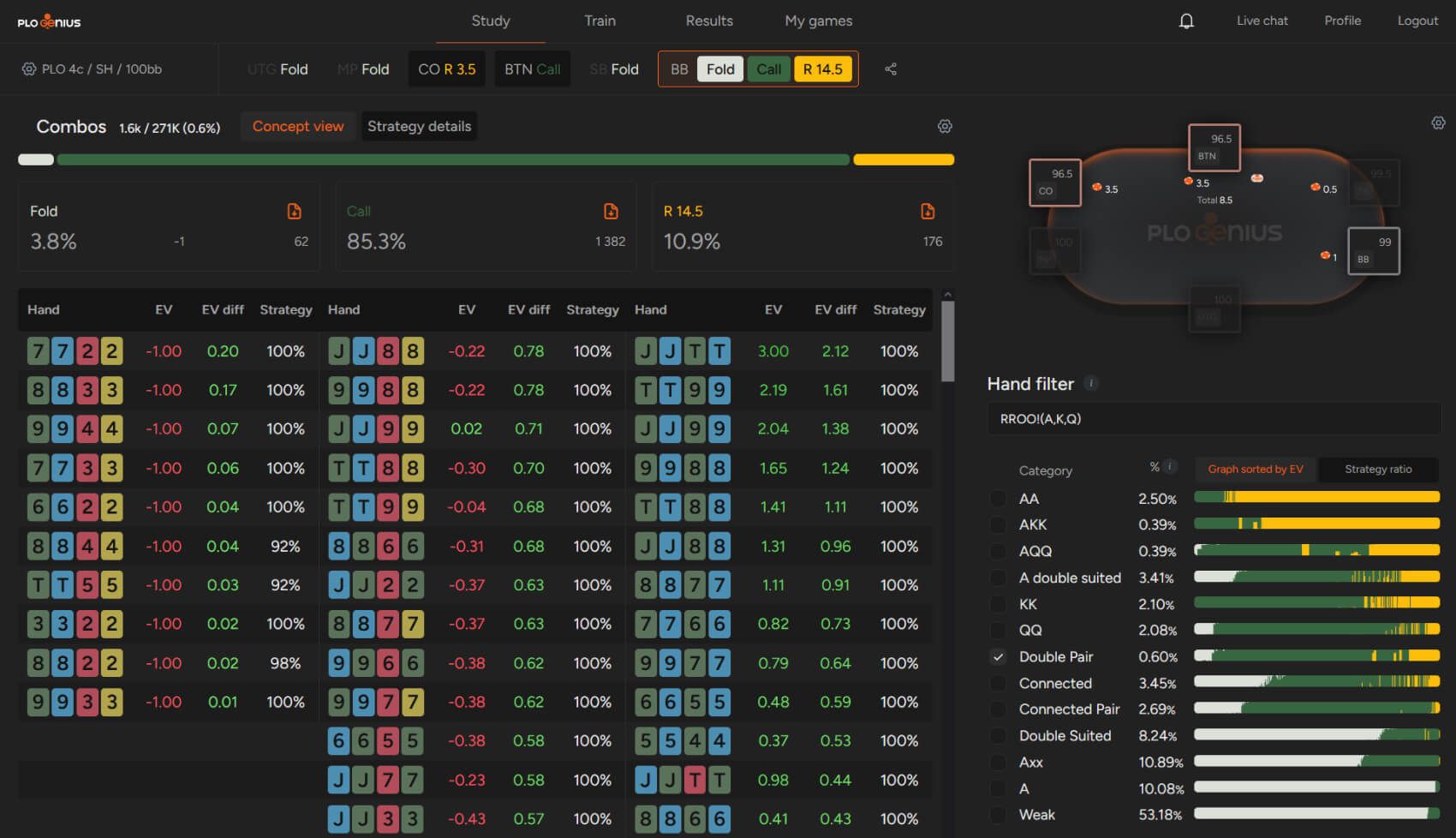
With tools like PLO Genius, you can also explore how to respond to different opponent actions. You’re not limited to simple heads-up spots — you can analyze multiway scenarios and get answers almost instantly.
Second, postflop play is where solvers become even more valuable. While preflop decisions in PLO are already complex, postflop play is significantly more demanding. That’s why modern tools continuously expand their postflop libraries — covering different stack sizes, formats (PLO and PLO5), and scenarios such as single-raised, 3-bet, and 4-bet pots.
By regularly studying with a solver, you not only learn optimal strategies but also develop a clearer intuition for how ranges interact — which ultimately leads to better decisions in real games.

Using Poker Tools to Improve Your PLO Skills in 2026
Today, poker tools are one of the most efficient ways to study and improve your game. In a competitive environment like modern online poker, relying solely on intuition is no longer enough — structured learning is essential.
Poker software allows you to analyze spots more precisely, understand strategic patterns, and identify both your own leaks and those of your opponents. Whether it’s equity calculators, tracking software, or solvers, each tool adds a different layer to your understanding of the game.
Using these tools consistently gives you a clear edge over the field. And most importantly — the earlier you start, the faster you build that advantage.