Same Hand, Different Table: What Actually Changes Your PLO Strategy
See exactly how rake, stack depth, and straddles change optimal PLO strategy.


Every decision at the poker table is influenced by what you expect from the players around you. For example, you do not need to be an elite player to see why your Button opening range should change depending on whether the Big Blind 3-bets every other hand or rarely raises.
Standard solver outputs do not account for the tendencies of your actual opponents. Instead, they assume optimal play and build the strategy around objective parameters such as the number of players, stack depths, rake structure, and the presence of an ante or straddle.
Even a seemingly minor adjustment, such as a different rake cap, can have a meaningful effect on optimal play. But how much does each variable matter? The Compare tool in PLO Genius can help you find out.
See How the Strategy Changes
PLO Genius includes an extensive collection of precomputed solutions for PLO, PLO5, and PLO6. If the postflop situation you want to study is not yet available, you can also request a custom calculation.
Each solution is built around a specific set of parameters. However, many players compete across multiple formats, stakes, and environments, so there is no single strategy that works everywhere. An approach suited to online 6-max cash games may be far from optimal in a live 8-handed game.
The Compare tool highlights the strategic differences between two selected configurations. Instead of moving back and forth between separate solutions, you receive an organized list of hands whose preferred actions change from one scenario to the other.
This makes it easier to identify the adjustments caused by different game conditions and develop a better intuition for how your ranges should change.
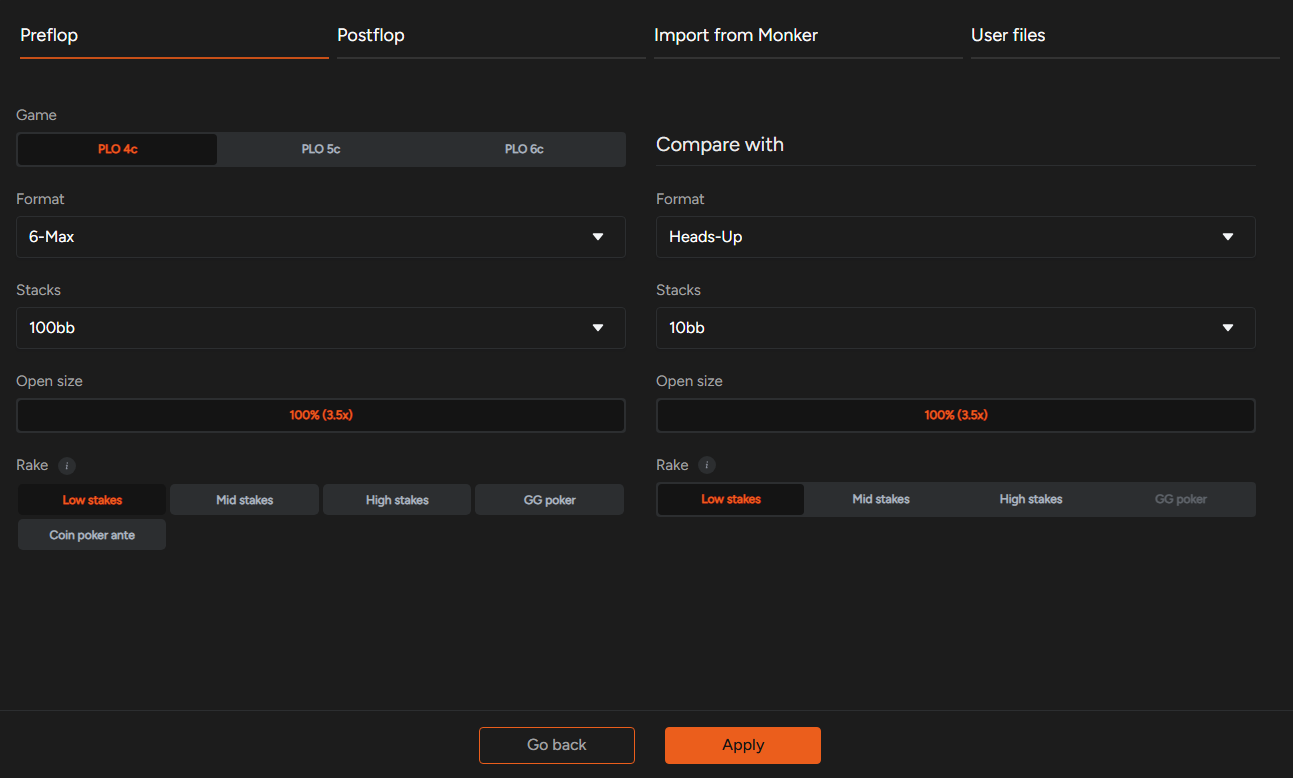
How Does the Compare Tool Work?
The process is straightforward. First, select the game and configuration you want to examine. Then choose another available setup within the same game to use as a point of comparison.
Suppose you have studied a solid 100 BB 6-max online strategy and are preparing to play in an 8-handed live game with a straddle and 200 BB stacks. The Compare tool lets you see the required adjustments directly. Although the nominal stack size doubles, the straddle is typically twice the big blind, so you still play roughly 100 BB relative to the largest forced bet. Stack depth is therefore not the main difference.
What changes is the number of players and blinds. With three blinds behind the Button instead of two, the optimal opening frequency falls from 47.5% to 37.04%. This comparison shows the overall adjustment required for the game you will actually play.
Tournament players, in turn, can examine how stack depth alone affects their defense. Comparing otherwise similar situations at 50 BB and 100 BB may reveal that the deeper configuration allows for more calling and 3-betting.
The presence of an ante works the same way: comparing games played with and without one shows how the additional money in the pot affects preflop incentives and changes optimal ranges.
Many other combinations are available, provided both configurations belong to the same game. Not every possible pairing will produce a meaningful insight, so the most useful comparisons are those that isolate a particular variable, such as:
- stack depth;
- table size;
- rake structure;
- antes or straddles;
- cash-game and tournament configurations.
The tool shows more than whether a particular hand prefers different actions in the selected scenarios. It also displays the expected value associated with those choices, helping you understand whether the difference is marginal or strategically important.
Comparing Strategies in Practice
To see the Compare tool in action, let us examine one of its most straightforward applications: comparing the same 100 BB 6-max cash-game configuration under two different rake structures — one representing PLO50 and the other PLO5000.
The first notable differences appear in how the blinds respond to a Button open. The Button opening frequencies remain relatively similar at both stakes: 48.3% at PLO50 and 47.5% at PLO5000. The strategies from the Small Blind and Big Blind, however, change considerably.

Calling is rarely optimal from the Small Blind in low-stakes games. Against a Button open, the solver calls only 2.46% of hands at PLO50. At PLO5000, where the rake is much lower, that frequency rises to 10.64%.
The difference becomes even more pronounced in the Big Blind — a position we cover in more detail in our guide to defending the Big Blind. At PLO50, the solver defends 26.06% of hands by calling. Under the PLO5000 rake structure, that figure increases to 43.18% — a difference of more than 17 percentage points. Applying either strategy at the wrong stakes could therefore lead to substantial EV loss.

Interestingly, the overall 3-betting frequencies remain similar in both configurations: the Small Blind 3-bets 9.71% of hands at PLO50 versus 9.17% at PLO5000, and the Big Blind 3-bets 10.03% versus 9.56%. This does not mean, however, that the ranges are composed of the same hands.
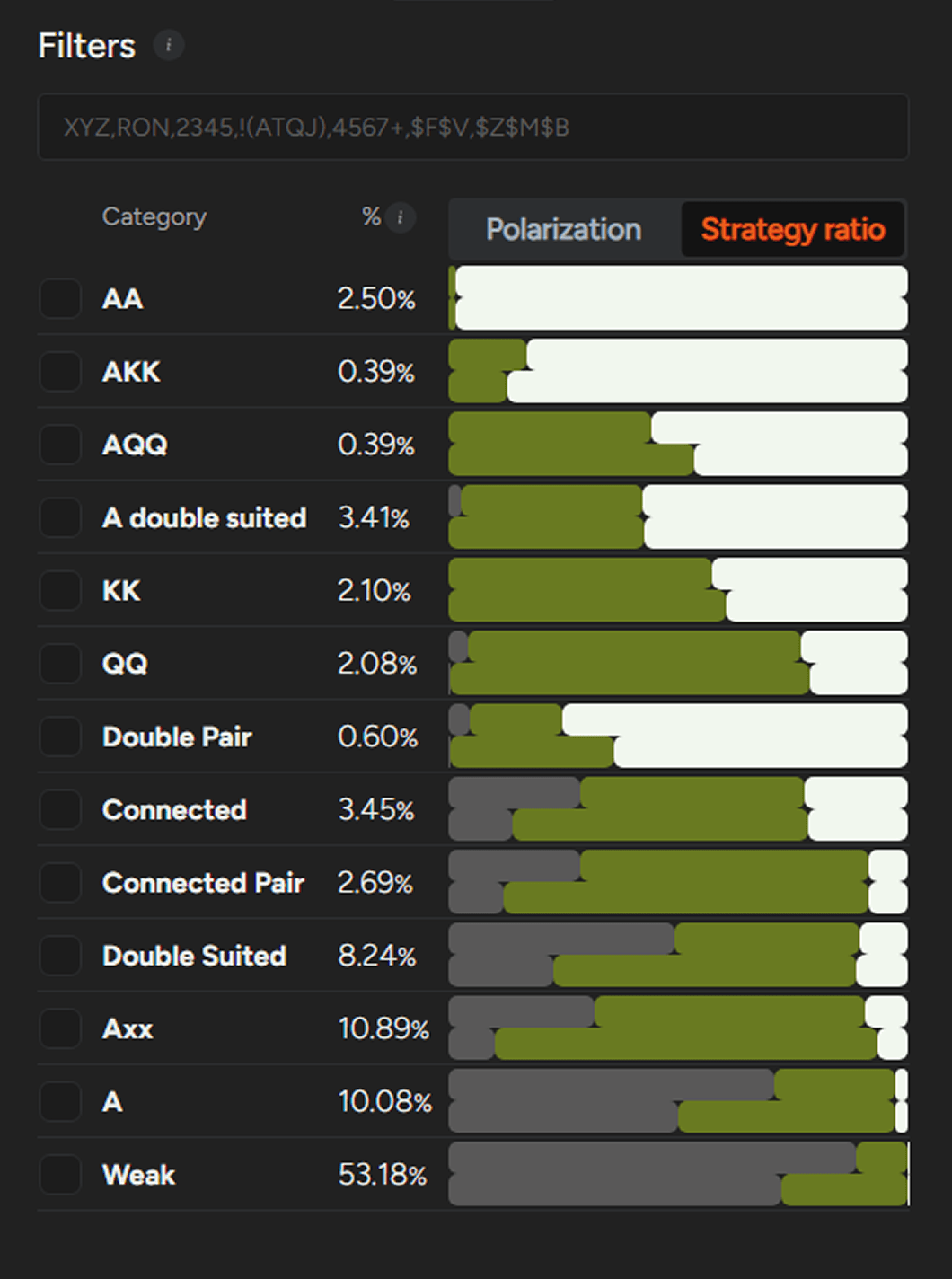
That's where the hand-category graph and additional filters come in — they let you examine these differences in greater detail. You can identify which types of hands change their preferred action and compare the expected value of individual decisions under each rake structure.
A Simple Way to Understand Strategic Adjustments
The Compare tool may not be the largest module in PLO Genius, but it can answer questions that are difficult to resolve by looking at individual ranges in isolation.
Its applications extend far beyond comparing rake structures. You can examine deeper-stack games, configurations with different numbers of players, or specialized formats such as All-in-or-Fold. As long as two available configurations belong to the same game, you can compare almost any setups that interest you.
Use it to prepare for a new format or isolate the effect of a single variable. Explore the available PLO Genius plans and start comparing the configurations most relevant to your games.