Taking Your First Steps in PLO MTTs
As the PLO tournament scene grows, stay one step ahead.


Multi-table tournaments are still a relatively niche format in Pot Limit Omaha. Most of the action in PLO traditionally happens in deep-stacked cash games, where the swings are large, and the games can get extremely aggressive.
That said, the tournament scene continues to grow steadily. Online platforms now regularly host large PLO MTT series with significant guarantees, while live tours such as the PokerGO Tour and the Triton Poker Series keep adding prestigious Omaha events to their schedules.
Just like in No Limit Hold'em, many skills transfer between cash games and tournaments — but there are also important strategic differences. Stack depths fluctuate constantly, ICM becomes relevant, and preflop ranges change significantly depending on the stage of the tournament.
That’s why studying preflop strategy is such an important starting point.
Our preflop library at PLO Genius allows you to explore tournament solutions across different stack depths and formats. Building a strong understanding of preflop ranges is essential if you want to navigate PLO MTTs effectively — especially since tournament stack sizes differ so much from standard cash game environments.
We believe PLO tournaments offer a lot, and we’ll continue covering different aspects of PLO MTT strategy on the blog. Today, however, we’d like to recommend an additional resource created by our friend Cory Mikesell — the e-book Tournament PLO: Let the Games Begin.
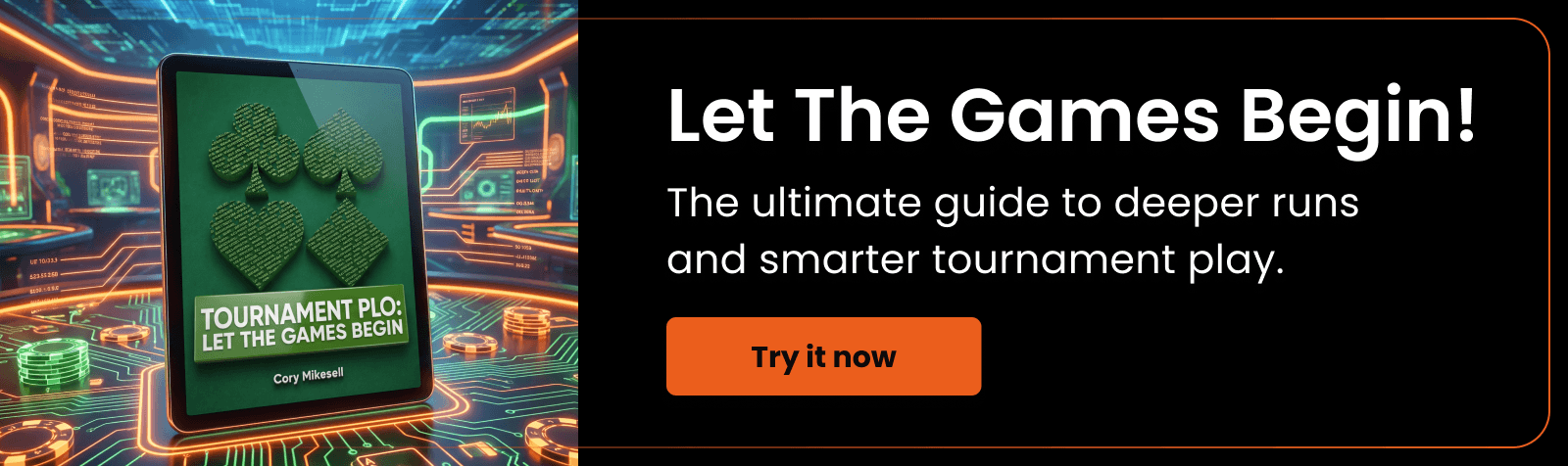
As Cory describes it:
The first and (as far as I can tell) the only book on PLO tournaments in the world. It includes over 100 pages of extensive analysis using MonkerSolver and PLO Genius, along with example hands taken from online tournaments with $1k buy-ins and above.
Cory is a professional online poker player, Heads-Up PLO specialist, coach, author, content creator, and National Chess Master. He works with 4-card, 5-card, and 6-card PLO across 6-max, Heads-Up, and tournament formats, and has built an extensive database of solver analysis covering different stack depths and game trees.
If you’d like to dive deeper into the world of PLO tournaments, it’s definitely a resource worth checking out.
You can preview the book and review the table of contents here.
We’ve also got a discount code for you: icanhazfinaltable? — use it at checkout to receive 25% off.