How Stack Depth Affects PLO Preflop Strategy
See how PLO opening and 3-betting strategies change from 100 BB to 200 BB.


Recently, we explored the Compare tool in PLO Genius, which offers a quick way to see how optimal strategy changes when you adjust the conditions of a game. Now, we will put it to practical use and identify the specific adjustments required across several common PLO setups.
Our starting point is a 100 BB 6-max cash game, one of the most common formats in online PLO, which we will compare with several alternative setups.
Over the next few articles, we will examine three comparisons:
- a 100 BB strategy versus a 200 BB strategy;
- a low-stakes 100 BB strategy versus a high-stakes 100 BB strategy;
- a standard 100 BB strategy versus a 100 BB strategy with an ante.
As a bonus, we will also explore what happens when an opponent plays far from optimally. By comparing standard solutions with node-locked ones, we can see how significant deviations in an opponent's strategy should affect our own.
We will begin with stack depth. How much should your preflop strategy change when the effective stack increases from 100 BB to 200 BB?
How Does Stack Depth Affect Your PLO Opening Ranges?
Deeper stacks create more room to maneuver postflop. If you have an edge over your opponents, they also give you more opportunities to benefit from their mistakes — particularly if those mistakes become larger or more frequent in unfamiliar deep-stack situations.
However, having an edge does not mean that you should simply play more hands. It can be tempting to open or 3-bet marginal holdings because you expect to outplay a weaker opponent later. In practice, those hands often create difficult situations with a high stack-to-pot ratio, especially when you are out of position.
So, what does theory tell us about opening ranges at 200 BB?
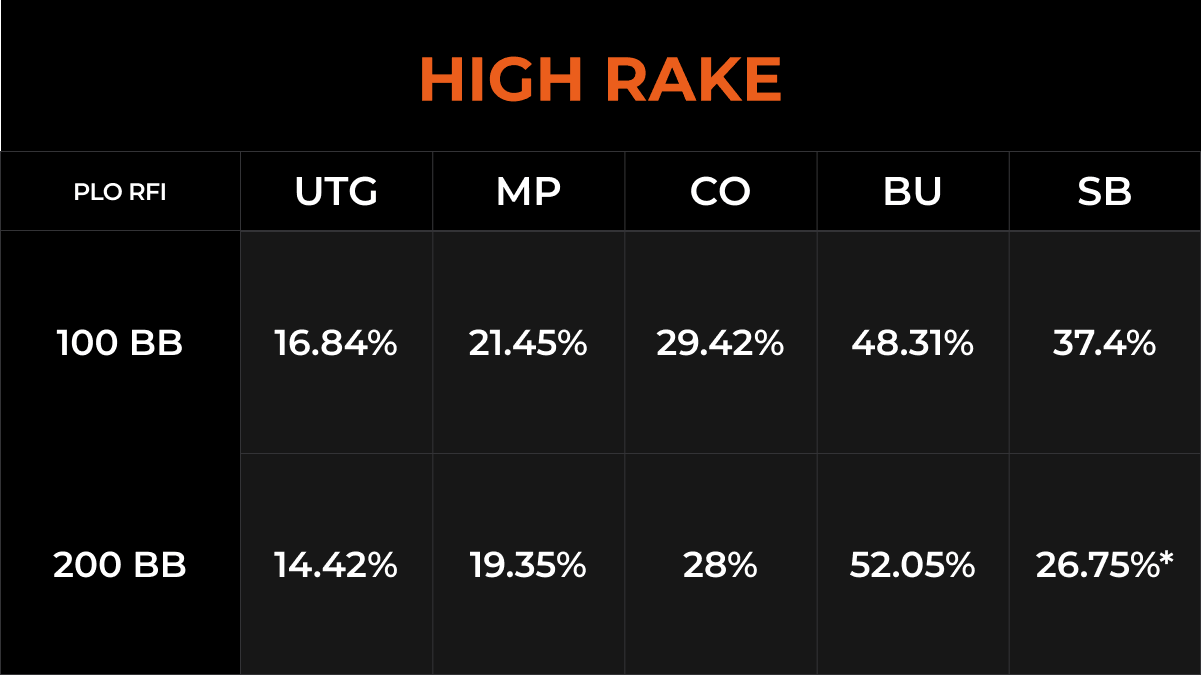
The chart compares 100 BB and 200 BB RFI ranges in a relatively high-rake environment, roughly equivalent to PLO50. The asterisk next to the Small Blind indicates that the 200 BB strategy includes a 12.91% limping range.
Perhaps surprisingly, optimal raise-first-in frequencies are lower at 200 BB from every position except the Button. Even there, the increase is less than four percentage points.
Because rake has a substantial effect on preflop strategy at lower stakes, it is worth checking whether the same pattern holds in a game where its impact is much smaller, such as PLO5000.
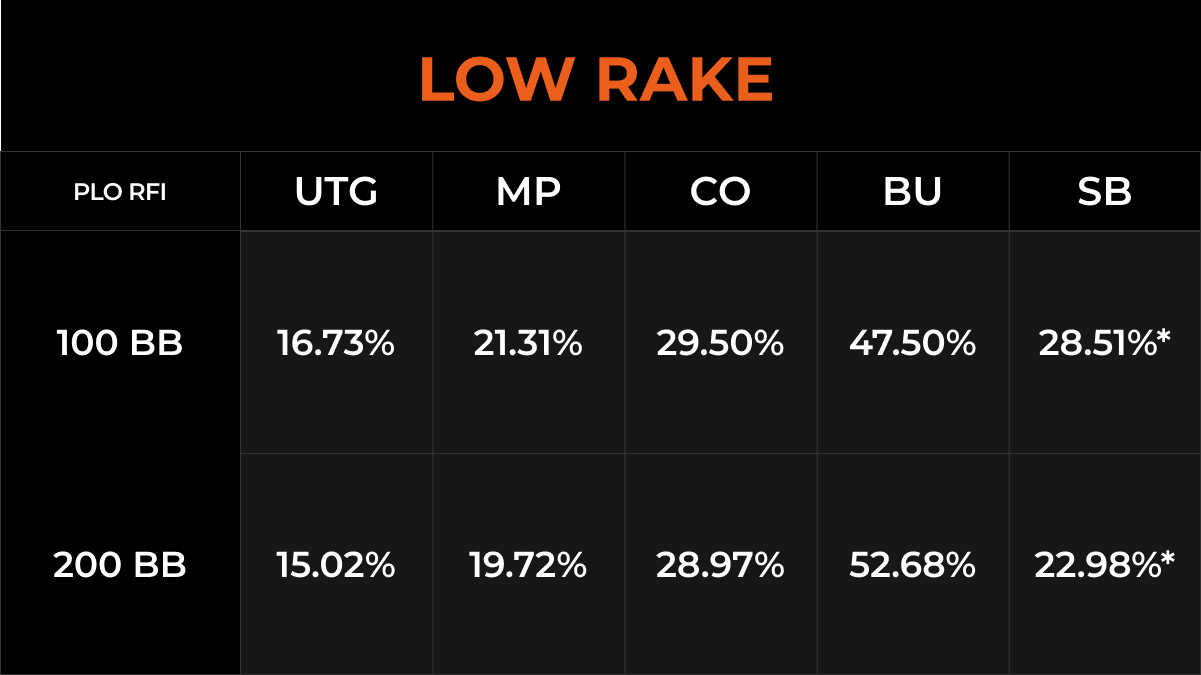
At these stakes, the Small Blind uses a limping range at both stack depths: 24.34% at 100 BB and 28.60% at 200 BB.
The rake structure changes the exact frequencies, but not the overall pattern. Moving from 100 BB to 200 BB generally does not justify widening your RFI ranges against reasonably balanced opponents. A larger effective stack does not automatically make marginal opening hands more profitable.
The Button is the only exception in both comparisons, although the increase is modest. This illustrates how valuable position becomes as stacks deepen: the player acting last is better equipped to realize equity, control the size of the pot, and navigate later streets.
From earlier positions, discipline becomes even more important. Opening too widely from UTG can lead to exactly the situations you would prefer to avoid — large, often multiway pots in which you must play out of position with a marginal range.
Pocket kings provide a useful example. At 100 BB, 58.29% of hands containing KK are opened from UTG. At 200 BB, that figure falls to 36.34%. A hand category that may initially look strong loses much of its appeal when the consequences of being dominated or poorly positioned become more expensive.
Opening ranges are only part of the picture, however. Deeper stacks also change how you should respond after another player has entered the pot.
How Does Stack Depth Affect 3-Betting in PLO?
Let us now compare the effects of stack depth on 3-betting and cold calling.
Here’s how the frequencies look in the most relevant in-position configuration: Button versus Cutoff.
- At 100 BB, the Button should cold-call 15.62% of hands and 3-bet 7.84%.
- At 200 BB, the Button should cold-call 11.16% and 3-bet 11.50%.
The Button's total VPIP decreases slightly, from 23.46% to 22.66%, but the composition of that range changes considerably. At 100 BB, calling is roughly twice as common as 3-betting. At 200 BB, the two actions are used at almost identical frequencies.
Double-paired hands show this shift particularly clearly. At 100 BB, these hands are cold-called 80.58% of the time and 3-bet only 5.74%. At 200 BB, the pattern is almost completely reversed: the calling frequency drops to 2.96%, while the 3-betting frequency rises to 84.93%.
Similar changes can be found among strong high-pair holdings such as AQQ and AKK. These examples highlight an important deep-stack principle: when you have position and a hand that benefits from building the pot or narrowing the field, greater aggression can be preferable to seeing the flop by calling.
The exact frequencies vary by configuration, but the broader tendency is consistent. When you are the in-position player, your 3-betting range generally expands slightly at 200 BB, allowing you to make better use of your positional advantage.
Out of position, the incentives are different.
How Does Stack Depth Affect Out-of-Position 3-Betting?
Most out-of-position 3-betting frequencies remain relatively stable between 100 BB and 200 BB. The clearest difference appears against a UTG open, where the deeper strategy shifts some hands from 3-betting into cold calling.
Consider the Small Blind against UTG:
- At 100 BB, the Small Blind should call 1.79% and 3-bet 4.69%.
- At 200 BB, it should call 3.05% and 3-bet 3.02%.
At 100 BB, 3-betting is clearly preferred to calling. At 200 BB, the two actions are used at almost the same frequency.
One reason is the postflop SPR. If the Small Blind 3-bets and UTG calls, the flop pot is 24 BB. This leaves 88.5 BB behind at 100 BB, producing an SPR of approximately 3.6. At 200 BB, the players instead have 188.5 BB behind and the SPR rises to about 7.85.
That difference is substantial. A lower SPR reduces the number and complexity of later-street decisions, which makes an out-of-position 3-bet easier to navigate. At the higher SPR created by 200 BB stacks, positional disadvantage remains relevant for much longer and mistakes can become considerably more expensive.
The most common out-of-position 3-bet configuration, Small Blind versus Button, changes much less:
- At 100 BB, the Small Blind calls 2.46% and 3-bets 9.71%.
- At 200 BB, it calls 2.03% and 3-bets 9.21%.
The decrease is small, but it follows the same general pattern found across the out-of-position configurations: deeper stacks do not call for more 3-betting simply because more chips are available. If anything, the strategy becomes slightly more selective.

Adapting Your PLO Strategy to Deeper Stacks
As you can see, preflop strategy changes as stacks get deeper, although most of these adjustments are subtle. To summarize the most important takeaways:
- Your overall RFI ranges become tighter as stacks get deeper, with the Button being the exception. This reflects the increased complexity of playing postflop out of position.
- Your 3-betting range expands when you are in position, allowing you to make better use of your positional advantage.
- You should be more selective when 3-betting out of position at deeper stacks. The higher the postflop SPR, the more difficult it becomes to play correctly without position.
These are only a few of the clear conclusions you can draw with the Compare tool. We will explore more practical PLO strategy adjustments in future articles. In the meantime, you can subscribe to PLO Genius to access an extensive library of solutions for all major PLO variants, compare strategies across different game formats and configurations, request calculations for any flop, turn, or river, and much more.