Big Blind Preflop Strategy: Part 2 – Defending vs Button Opens
The Button attacks wide — your Big Blind defense should adjust accordingly.


In our recent article, we looked at one of the toughest preflop configurations in Pot Limit Omaha: defending the Big Blind against an UTG open. Today, we’ll move a few positions further and examine how Big Blind strategy changes when facing a Button raise.
The shift in position changes the dynamics significantly. Although you are still playing out of position and dealing with rake pressure, the Button attacks much wider than UTG, which fundamentally alters how the Big Blind should respond. Facing a weaker and more expansive opening range allows you to defend considerably wider and apply aggression much more frequently.
Understanding the Difference in Ranges
To understand why adjustments are necessary, we first need to look at how different the opening ranges actually are. Assuming you are playing against a theoretically sound opponent at PLO50 or an equivalent rake structure, UTG should open roughly 16.8% of hands, which translates to approximately 45,500 combinations.
This creates a range heavily concentrated around premium holdings and strong high-card structures. Around 6,700 combinations in the UTG range are AA holdings, meaning that when defending the Big Blind against UTG, you will run into Aces roughly one out of every seven times.
The Button operates under completely different incentives. A GTO Button opening range expands to roughly 48.3% of hands — nearly 131,000 combinations. While the absolute number of AA hand remains identical, they now account for only slightly above 5% of the total range. As a result, when defending against a Button open, you will face premium holdings significantly less often.
More broadly, the Button range is not only much wider but also considerably less concentrated around premium high-card holdings. While it naturally covers a wider variety of board textures, its average hand strength drops substantially. Even without running simulations, one conclusion becomes clear: the average Button holding is meaningfully weaker than the average UTG holding.
That difference alone changes optimal Big Blind defense significantly, allowing you to continue much wider and apply aggression more frequently.
How Should You Defend the Big Blind Against a Button Open?
Against a theoretically sound UTG opening range under PLO50 rake assumptions, the Big Blind should defend by calling roughly 13.6% of hands (36.6K combinations) and 3-betting 3.9% (10.5K combinations), resulting in an overall defending range of roughly 47K combinations.
The Button changes these numbers dramatically. Optimal defense expands to roughly 26.1% calls (70.5K combinations) and 10% 3-bets (27K combinations), producing a defending range close to 97K combinations overall.
Even though you remain out of position and continue fighting against substantial rake, facing a much weaker opening range allows you to continue significantly wider. Compared to BB versus UTG, you can now defend nearly twice as many hands.
Here's a visual comparison of optimal Big Blind responses versus UTG (left) and Button (right).
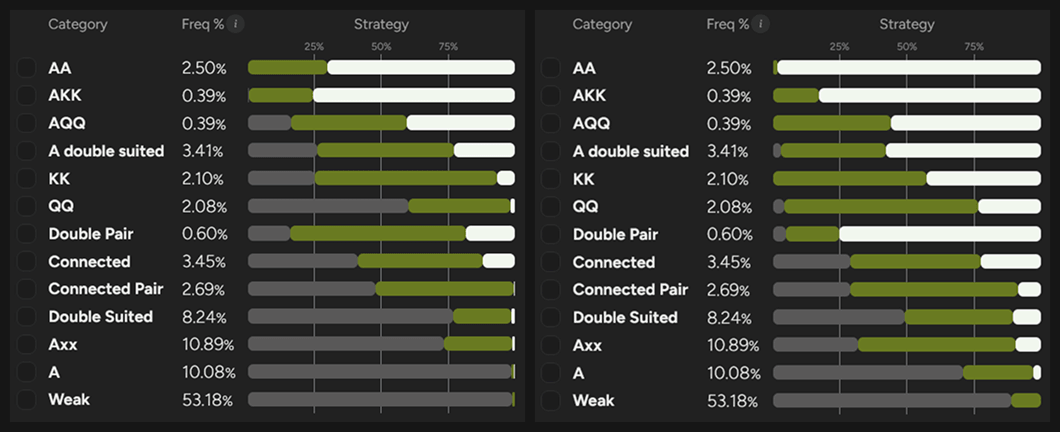
Now, let’s break down how individual hand categories change.
Aces
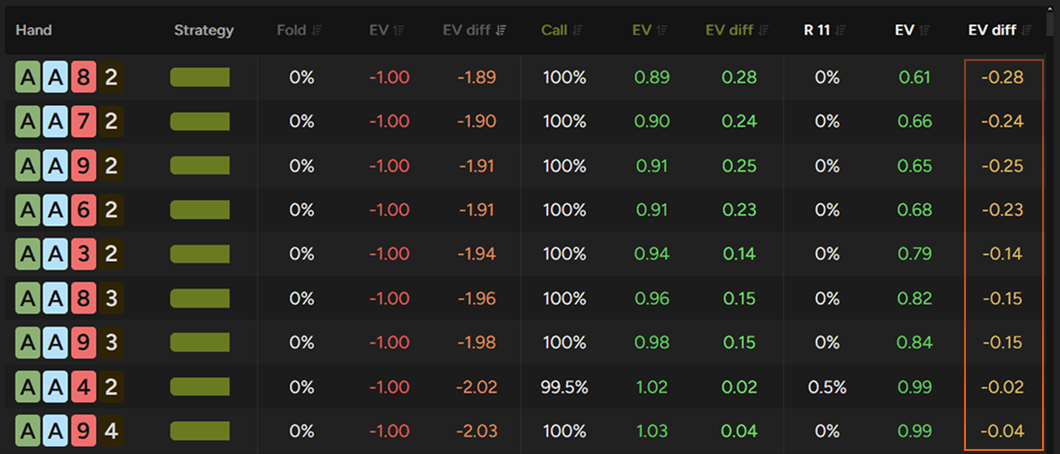
As expected, Aces remain the easiest category to navigate. Against the Button, strategy becomes considerably simpler compared to defending versus UTG, as almost every AA combination becomes strong enough to enter the 3-betting range.
The exceptions are fairly intuitive. They mostly consist of rainbow structures with weaker side cards that lack nutted potential and therefore prefer calling.
Importantly, this category is also quite forgiving when it comes to simplification. Even if you elected to 3-bet every AA combination in this configuration, the EV loss would remain relatively small. While solver outputs still prefer mixing in some calls, simplifying toward aggression performs considerably better than becoming too passive.
Kings and Queens
Once we move beyond Aces, things become slightly more nuanced. As usual, one of the most important factors when evaluating KK and QQ holdings is whether the hand contains an Ace.
AKK combinations remain relatively straightforward. Virtually none should fold, and the overwhelming majority become 3-bets. Around 83.1% of AKK holdings prefer aggression, while only rainbow variants and a small number of weaker trisuited combinations prefer calling. In practice, these weaker continues mostly consist of AKK holdings containing side cards like a deuce, six, seven, or nine.
AQQ follows a similar pattern. None of these holdings fold, while 55.9% move into the 3-betting range. The remaining combinations generally continue as calls, consisting primarily of rainbow hands, most trisuited variants, and a small number of weaker single-suited holdings such as AQQ2.
The importance of blocking AA becomes particularly visible once your hand no longer contains an Ace. KK and QQ holdings without an Ace become considerably more selective and begin splitting much more meaningfully between calls and raises.
KK combinations, for example, split between calling and 3-betting at roughly a 57.3% to 42.7% ratio. Calling becomes the default option, while the holdings that still prefer aggression usually compensate through other premium qualities — double suitedness, additional pair value, or stronger side-card quality.
Hands such as K♦K♣8♦2♣, K♣K♦J♦9♦, or K♣K♦J♠J♥ generate enough EV to continue aggressively despite lacking an Ace blocker.
More broadly, Kings — and especially Queens — become easier to play against Button opens than versus UTG. Since AA represents a significantly smaller portion of the Button range, high pairs retain their value more consistently, allowing almost all KK and QQ holdings to continue profitably.
Double-Suited Ax
Double-suited Ax becomes another category that performs exceptionally well against Button opens. In practice, most of these holdings should continue, meaning the key question is no longer whether to VPIP, but rather whether a hand performs better as a call or as a 3-bet.
One of the clearest indicators for aggression is broadway support. Holdings that combine an Ace with multiple strong broadways frequently move into the 3-betting range. Structures containing combinations like AKQx, AQJx, or AJTx often perform well enough to prefer aggression.
Connectedness also plays an important role. When side cards remain reasonably high and stay relatively connected, hand quality rises quickly. Double-suited Ax holdings with side cards six or higher and no more than one or two gaps frequently gain enough EV to move beyond calling.
The final premium characteristic is pair strength. Double-suited Ax structures containing medium or stronger pairs perform particularly well as 3-bets, as the added pair equity combines naturally with nut potential and strong board coverage.
Overall, this category highlights a recurring pattern in Big Blind defense versus the Button: hands that combine multiple premium characteristics gain value quickly and often shift from passive continues toward aggressive play.
Double-Paired Hands
Double-paired hands remain another highly profitable category when defending against Button opens. Solver outputs show that only 4.7% fold outright, while 19.8% continue as calls and as much as 75.4% enter the 3-betting range.
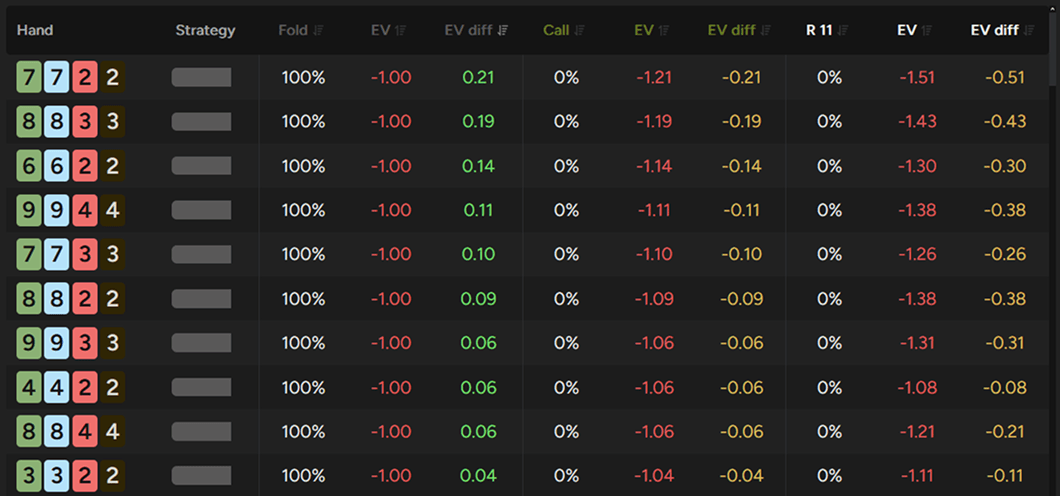
The folding portion is relatively easy to identify. These hands are exclusively rainbow holdings built around weaker low pairs — typically deuces, treys, or fours — that either cannot make straights at all or primarily make non-nut straights. Hands like 8844, 9922, or 5522 (all rainbow) fall into this category.
The calling range improves somewhat in connectivity but still tends to consist of rainbow or single-suited holdings that often lack nutted straight potential. Hands like 9933 single suited, TT66 rainbow, or JJ55 rainbow frequently perform well enough to continue but not strongly enough to justify aggression.
Most remaining double-paired holdings move into the 3-betting range. The strongest performers usually combine closely connected pairs with strong suit quality, particularly double-suited hands with one or no gaps between the paired cards. Holdings like 7766, TT88, or 8877 generate enough EV to become clear raises.
The reason these hands perform so well is fairly intuitive. The ability to flop one of two sets alongside strong straight and flush potential creates holdings that realize equity exceptionally well across many runouts.
Connected & Connected Pair Hands
Unsurprisingly, this is where things become considerably more complex, as both categories contain a healthy mix of folding, calling, and 3-betting.
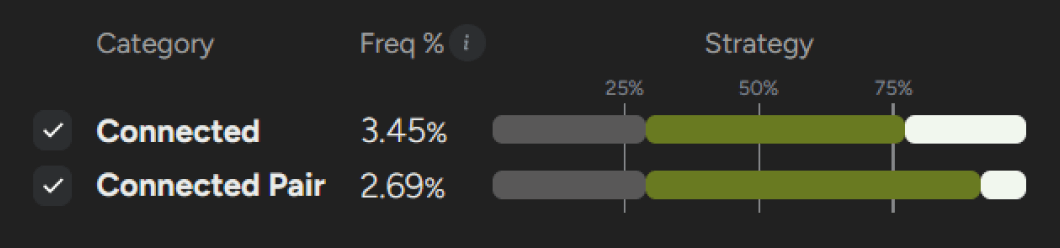
Starting with the folding range, it consists primarily of lower-card holdings (generally below Ten-high) that lack suit quality and are either rainbow or trisuited. Many of these folds are fairly intuitive, but some can still come as a surprise. Hands like 9865, QJ98, or 7764 — all rainbow — may appear playable at first glance but ultimately fail to generate enough EV to continue.
On the opposite side of the spectrum sits the aggressive portion of the range. Leading the way are premium double-suited broadway holdings, particularly combinations built around strong cards between King and Nine. Double-suited pairs with connected side cards also perform exceptionally well, with hands like JJT8, QJTT, or 9887 frequently preferring aggression.
Double-suited rundowns with no more than one gap similarly generate enough EV to move into the 3-betting range. The final portion of aggressive continues consists of premium single-suited holdings that compensate through strong high-card quality, such as AKQT, KJT9, or KJTT.
That still leaves roughly 55% of both categories combined, which forms the calling range.
Just like in BB versus UTG configurations, this is one of the most valuable areas to study if you want to sharpen your preflop intuition. Many hands in these categories show only small EV differences between available actions, making them particularly valuable from a learning perspective.
Double-Suited Hands
Double-suited hands are another category where players without a strong theoretical foundation frequently make mistakes. While double suitedness is naturally a powerful characteristic in Pot Limit Omaha, many players tend to overestimate its value.
Solver outputs show that even against a wide Button opening range, 49.2% of double-suited holdings should still fold preflop.
Fortunately, the folding portion is relatively easy to identify. It consists primarily of hands built around multiple low cards, particularly holdings containing two smaller side cards between deuce and seven. As a practical guideline, having a deuce or trey in your hand should often serve as a signal to approach the holding more cautiously.
On the aggressive side, premium King-high, Queen-high, and Jack-high holdings frequently move into the 3-betting range. This portion consists largely of strong three-card rundowns like K765 or JT96, as well as paired holdings with stronger side-card quality, such as TT76 or QT88.
Importantly, many hands that technically prefer 3-betting only outperform calls by relatively small EV margins. As a result, simplifying toward calling will often perform perfectly well, particularly against opponents who continue too wide or play too aggressively postflop.
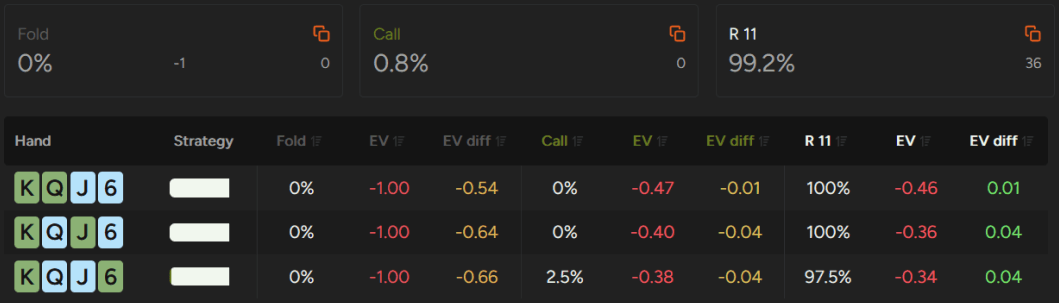
Ace Highs
Last but not least, Ace-high holdings — both suited and unsuited. While not the most exciting part of your range, they remain important simply because of volume, accounting for roughly 57,000 combinations, or around 21% of your overall range.
Solver outputs show a fairly passive approach here. Roughly 50.5% of these holdings fold outright, while only 6.3% prefer 3-betting, leaving 43.2% as calls.
Importantly, even the aggressive portion does not consist of exceptionally powerful hands. As a result, missing an occasional thin 3-bet with holdings like AKJ9 single suited or AKT9 is unlikely to carry a meaningful EV penalty.
The key skill in this category lies in identifying which Ace-high holdings generate enough EV to continue versus an open.
Weak Hands
Finally, we arrive at the largest category in your range — and also the weakest one. Weak hands account for roughly 53% of all holdings, yet only around 11% continue against a Button open.
Caution is particularly important here. While these holdings naturally perform better against a Button opening range than versus UTG, they still represent an overall low-EV region.
The hands that continue usually compensate through secondary qualities rather than raw card strength alone. Three-Ace holdings, paired hands with additional playability (such as KT99, JJ43, or JT77 single suited), or selected trisuited high-card combinations frequently generate enough EV to continue.
When navigating this category, erring slightly on the side of overfolding will generally perform better than defending too wide.

Defending Against the Button Creates More Room to Improve
Defending the Big Blind against Button opens creates significantly more strategic flexibility than defending versus UTG. Because the Button attacks much wider, optimal defense expands dramatically as well.
At the same time, many decisions in this configuration operate on relatively small EV margins. Learning where those thresholds sit — and building intuition around them — often creates some of the biggest long-term improvements in preflop play.
Hopefully these guidelines help sharpen your Big Blind defense and make Button opens easier to navigate. If you’d like to explore exact solver outputs across different positions, stack depths, and configurations, PLO Genius gives you the tools to study them in depth.