What’s the Deal with Double Board PLO (and Bomb Pots)?
Let’s dive into double board PLO and bomb pots.


PLO games in various areas often offer twists that change how they play out and the correct GTO strategy. Among many ideas and variants, the most popular is playing with two boards (sometimes in the "Bomb Pots" format).
If you've never played PLO (or PLO5) with two boards, you'll be surprised how differently the game plays out. An additional board adds a whole layer of complexity, which many players (as is often the case when a niche idea becomes popular) are unaware of. The game feels so fresh and challenging that even some live No Limit Hold 'em games implement an occasional PLO Bomb Pot every dealer change!
It seems like the double board PLO and Bomb Pots are inclined to become more popular. Unsurprisingly, if a skill-intensive game variant becomes in demand, it is worth learning, as a large part of the population is completely unaware of how to play it.
So, let’s dive a little deeper into the rabbit hole and examine how to tackle the double board PLO.

What Changes in Double Board PLO?
Let's start with the basics. The double board PLO (sometimes even PLO5 and PLO6) is a split game, meaning the pot is split into two halves, one for each board, usually dubbed top and bottom. The mechanic of splitting the pot works similarly to the "Run It Twice" feature.
Most importantly, you must have the best hand on both boards to win a whole pot at a showdown. And, as you might suspect, that's not an easy feat, so you will often end up chopping the pot and sometimes even splitting one half of it (if more than one player has the same straight, for example).
An even more intricate variant of double board PLO is "Bomb Pot." Depending on what's popular in your region, they can be an occasional occurrence (like one hand after dealer change in an NLH game) or a regular game.
Straight to the Flop: No Preflop in Bomb Pots
Bomb Pots have two distinctive characteristics.
The most important one is that there's no preflop betting — everyone is in the pot on the flop. That means the hand can start with as many as eight people in!
The second thing to note is that before the Bomb Pot is dealt, players post ante instead of the Big Blind and Small Blind. As a result, the average pot is way bigger as the ante (depending on the home rules) can be as big as 10 BB. Although there's no set limit, the most popular number is 5BB.
Double Board PLO and Bomb Pots: Key Concepts
Like every other poker game, PLO Bomb Pots is full of nuances and has its own metagame, which you learn over time. For now, let's focus on a few important basic takeaways that can save you a lot of money.
Take card removal into account
In poker, you usually don’t have much reliable information about which cards are still in the deck and which are already out. The rare exceptions happen in live games, when cards are accidentally exposed.
In double board PLO, however, one important piece of information is always available: cards on one board are “dead” on the other.
This becomes intuitive quickly, but it’s worth keeping in mind. For example, if the boards are A♠4♦6♣ and A♥A♦7♠, and you hold the last remaining Ace♣, no other player can have trips — all Aces are already accounted for.
A similar concept applies to draws. Suppose the top board is K♣J♣2♦ and the bottom board is A♣6♠5♥. If you hold the Q♣ along with another club, you have a nut flush draw on the top board and a backdoor nut flush draw on the bottom one.
Aim for freerolling (or a decent chance to scoop the whole pot)
Usually, to put more money into the pot in double board PLO, one of two things should be true.
You either have one board “locked up” — meaning you hold the effective nuts with little or no risk. This could be the nut flush on an unpaired board or a strong full house on a paired one.
Or your hand has solid equity across both boards. For example, you might hold a middle set with a backdoor flush draw on one board, and a nut flush draw with a nut gutshot on the other.
What’s the logic behind this approach?
Your main goal is to scoop — win both boards and take the entire pot. Hands that dominate one board are especially valuable, because once you secure half the pot, the rest effectively becomes a freeroll. Any equity on the second board turns into additional upside.
The next best scenario is having strong equity on both boards. In heads-up pots, this usually means over 50% equity per board; in three-way pots, just over 33% per board is already enough.
Straights are not as good as in regular PLO
n double board PLO, the nuts can be either absolute or shared.
Absolute nuts never chop. These include nut flushes, top full houses, or better, and they guarantee you at least half of the pot by winning one board outright.
Shared nuts are much weaker than they might seem. In regular PLO (or NLH), chopping is a neutral outcome. In double board PLO, however, things change.
If your hand is likely to be shared — for example, a straight — you will often split one half of the pot. This means that even if you win the other board, your best-case scenario is only a quarter of the total pot.
Know what’s your aim (pushing and pulling)
You’ll often find yourself in a spot where you have one board locked up but little to no chance of winning the other. What should you do?
It depends on how many players are still in the hand.
If you’re heads-up, betting big is usually the better option. In the worst case, you end up chopping the pot, and sometimes you can push your opponent out and scoop the entire pot.
In multiway pots, the situation changes. If you’re confident you’ve secured one board but have no realistic chance on the other, a more passive approach is often better.
When you’re effectively playing for half of the pot — even with very strong hands like quads or a straight flush — your goal is to make that half as large as possible. By keeping more players in the hand, you increase the size of the pot and your expected return.
If you start betting aggressively, you’ll often force out weaker hands and end up against a player who also has one board locked up. In that case, you’re no longer making extra money — you’re just splitting what’s already there.
Why You Shouldn’t Ignore Bomb Pots
Some players see double board PLO and bomb pots as unnecessary complexity. You might even consider sitting them out — but in most cases, that’s a mistake.
In live games, bomb pots take up a meaningful portion of your session. If one occurs every dealer change, and the dealer rotates roughly every 30 minutes, a single bomb pot can take around five minutes to play. That adds up to about one-sixth of your total table time.
At the same time, these pots are much larger than average. In an eight-handed game with a 5 BB contribution, you’re already playing a 40 BB pot on the flop. When handled correctly, these spots can have a significant impact on your overall win rate.
Just as importantly, most players are not well-prepared for them. In live environments, decisions are often based on intuition rather than structured strategy. Even regular PLO players tend to neglect studying bomb pots.
As a result, these spots offer a clear opportunity to gain an edge — both in bomb pots themselves and in double board PLO more broadly.
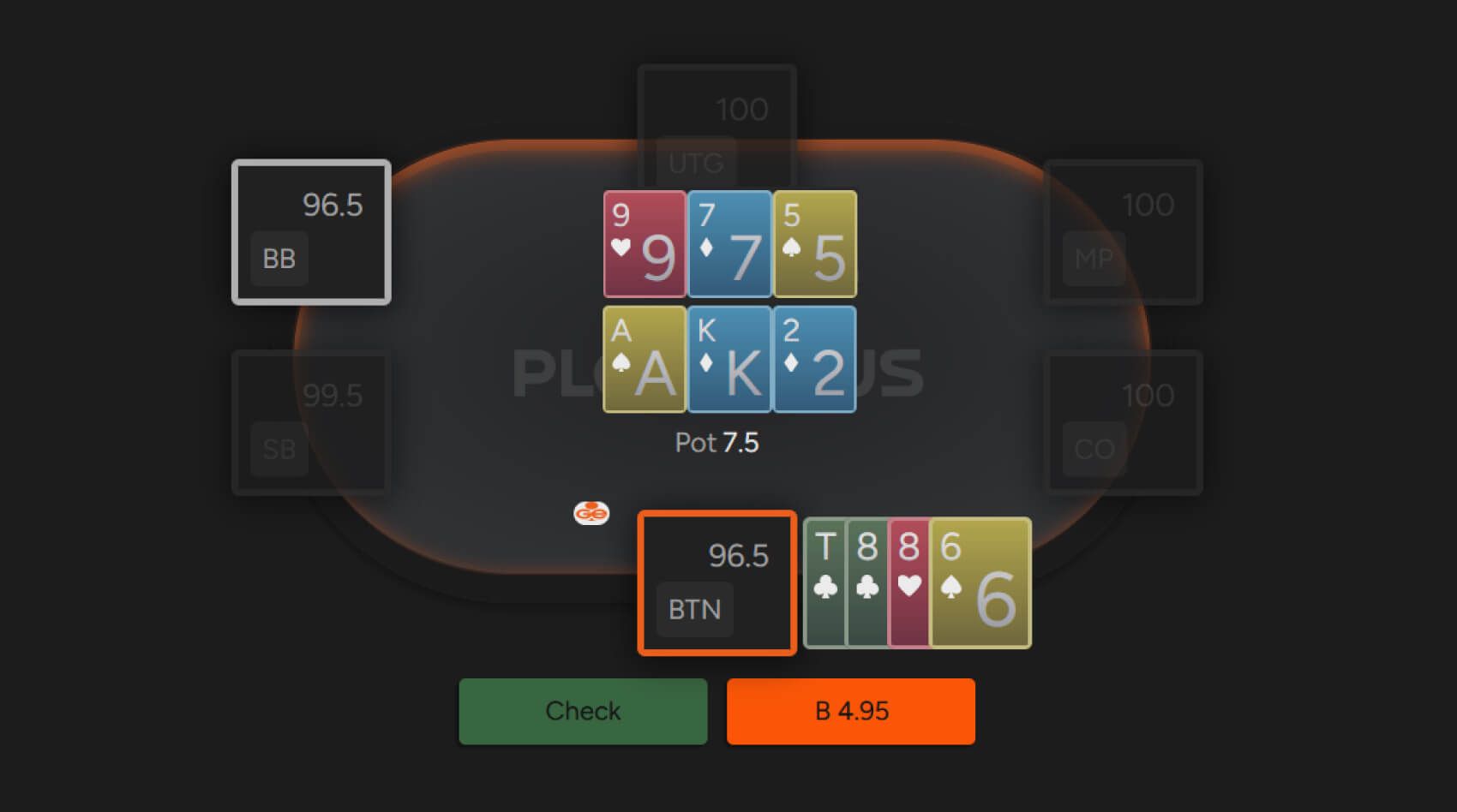
Simplifying Decisions in Double Board PLO
Bomb pots are still relatively unexplored, especially compared to standard PLO. They are most common in live games, which makes them even less studied. Because of that, it’s important to simplify your decision-making as much as possible.
One useful way to think about these spots is through board texture. As in other community card games, boards can be dynamic or static. Dynamic boards tend to change significantly on later streets, often due to multiple draws. Static boards are more stable, where the nuts on the flop are more likely to remain the nuts by the river — for example, on disconnected or paired textures.
When facing a bet, ask yourself which board your opponent is likely focusing on and what is driving their decision, especially in multiway pots.
In practice, most bets are driven by the more static board. That’s where players can extract immediate value or protect their hand. On dynamic boards, players are more likely to check when their hand is still drawing.
It’s also important to understand that the math works differently in double board games. In regular PLO, facing a pot-sized bet requires around 33% equity to break even. In double board PLO, if you can realistically win only one board, you need about 66% equity to break even. That’s a huge difference and makes bluff-catching far less attractive.
This leads to another important point: betting and calling are not equivalent in these formats.
If you bet pot with a strong hand on one board (but not the nuts) and little equity on the other, several outcomes are possible. You might get called and chop, get raised and fold, or force your opponent to fold and scoop the entire pot.
If you check in the same spot and your opponent checks back, the most likely outcome is simply chopping the pot.
That’s what makes double board PLO unique — aggressive play can create additional ways to win, while passive play often caps your upside.

Why Double Board PLO Is Worth Exploring
Even if double board PLO doesn’t seem like your type of game, it’s worth giving it a try — even at micro stakes.
At first glance, it may look like pure gamble. In reality, there’s much more depth to it, and understanding the fundamentals can give you a clear edge. On top of that, it’s simply a very entertaining format.
If you’d like to build a stronger foundation in Pot Limit Omaha — both preflop and postflop — tools like PLO Genius can help you understand how ranges interact across different board textures, whether you’re playing one board or two.